
Your Marks Are The Smallest Part Of The Story#
Ask a group of Class 12 students what a bank checks before granting an education loan and most will say "percentage". Percentage does matter, but it is rarely what decides the outcome. Bankers ask a wider set of questions, and each has a clear answer in the rules.
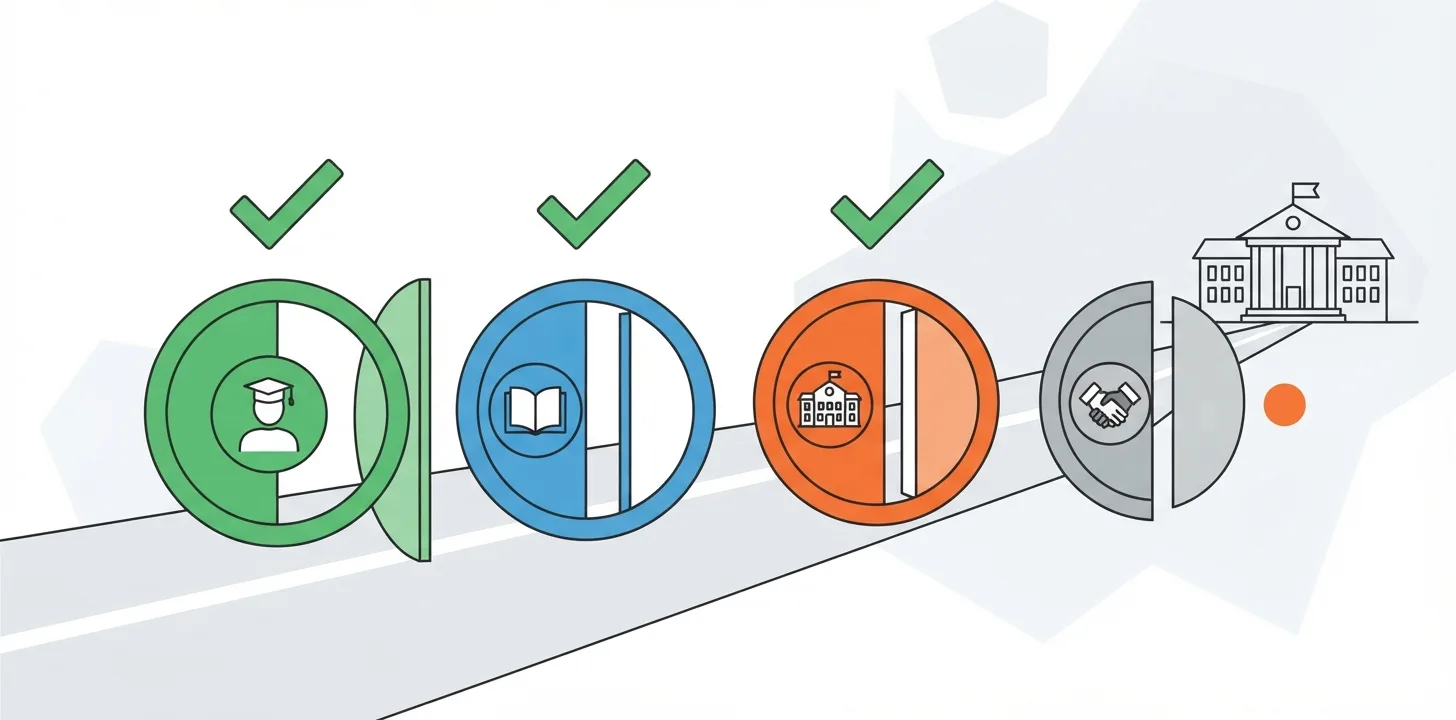
Broadly, an education loan is judged on four tests: the student, the course, the college and the co-applicant. Pass all four and the loan moves smoothly. Fail one and you usually still have a fix, provided you know which test you failed.
This guide lays out each test, what the published rules say, and which parts are firm and which are simply lender preference. I used the Indian Banks' Association (IBA) model scheme, SBI's published terms and the government's PM-Vidyalaxmi guidelines, and I flag where comparison sites describe rules that are only one lender's habit.
Background: Why Banks Ask So Many Questions#
An education loan is unusual. Most loans are given against something the borrower already has: a salary, a house, a car. An education loan is given to someone who has neither, against something that has not yet happened: a degree and a future job.
Banks handle that uncertainty in three ways. They look at the quality of the admission and the course, because these predict future earnings. They ask for a co-applicant, usually a parent, whose income and credit record stand behind the loan. And above certain sizes, they ask for collateral, meaning property or deposits that can be claimed if repayments stop.
Two other terms matter. Margin is the portion of the cost you fund yourself; the bank finances the rest. CIBIL score is a three-digit credit score, from about 300 to 900, that summarises how reliably you and your co-applicant have repaid past loans and credit card bills. Higher is better. Lenders use scores from credit bureaus like CIBIL to judge risk.
Now the four tests.
Test One: The Student#
The IBA model scheme is admirably short here. The student should be an Indian national and should have secured admission to a professional or technical course, in India or abroad, through an entrance test or a merit-based selection process. That is the core, and public sector banks largely follow it.
Age. The model scheme says there is "no specific restriction with regard to the age of the student". Many comparison sites nonetheless state an age band of 18 to 35. That is a habit of individual lenders, and you should treat it as a common practice rather than a rule.
Marks. Most lenders look for a pass in the qualifying exam, and some quote a minimum of 50 per cent. Comparison sites give this as typical, not universal. Premier-institution schemes look at your entrance rank more than your board marks.
Admission route. This is the sleeper. PM-Vidyalaxmi states that students admitted through management quota or a similar quota are not eligible for its collateral-free loans. Other banks may still lend on such admissions, but the scheme with the best terms will not.
NRI and overseas. SBI's schemes are available to Indian nationals, including NRIs, for approved courses.
Tests Two And Three: The Course And The College#
Test Two: The Course#
Banks lend for courses they can connect to employment. The IBA's indicative list covers graduation, postgraduate and professional degrees and diplomas, including engineering, medicine, management, law, teacher training and computer courses, offered by recognised universities, colleges and institutes. SBI's summary also lists professional qualifications such as CA, ICWA and CFA.
Full-time and recognised. Full-time programmes from institutions recognised by UGC, AICTE, NMC or similar bodies are the safest. A short unregulated certificate course or an unrecognised diploma may be refused or be limited to a small skill loan. SBI has a separate Skill Loan scheme, priced at 9.40 per cent for loans up to ₹7.5 lakh without collateral on its June 2026 card.
Study in India or abroad. Overseas courses have their own schemes, higher margins and a wider set of documents.
What is financed. The cost of study, not a general cash need. The model scheme covers tuition, hostel, books, equipment, exam and library fees and project costs. PM-Vidyalaxmi's guidelines add a reasonable laptop and living expenses.
Test Three: The College#
Here the same student can be treated very differently depending on where the seat is.
Premier institutions get better terms. SBI's Scholar Loan lists institutions in four tiers, with collateral-free limits from ₹50 lakh for List AA down to ₹7.5 lakh for List C.
PM-Vidyalaxmi uses a published quality list. The institution must be in the top 100 of the NIRF rankings (overall, category or domain), or among the top 200 state or union territory institutions, or be a remaining central government institution. The first list contained 860 institutions. Indian campuses of foreign universities and foreign campuses of Indian ones are excluded.
Everyone else falls back on the general schemes, where the bank still checks that the institution is recognised and its fees are reasonable, and where limits and collateral demands depend on the amount.
If your college is unlisted, that is not the end. A general Student Loan works for recognised institutions. It simply carries a higher rate and expects more security.
Test Four: The Co-Applicant#
This is the test that ends the most applications, so it deserves the most attention.
Who can be one. Usually a parent or legal guardian. Some private banks accept a wider set of relatives. One large private bank, according to a comparison site, extends this to grandparents and other close family, which helps students whose parents are unavailable.
What the bank wants to see. Steady income and a clean repayment record. Some lenders quote a minimum monthly take-home of about ₹30,000. That is a lender preference, not a regulation.
Credit score. Comparison sites commonly quote a minimum of 700 for both the applicant and the co-applicant, and a few private lenders accept 650. Public sector banks' actual thresholds are not always published. If the co-applicant has a poor score, fix it before applying, since applications leave a mark on a credit record.
What if the co-applicant has no income? A pensioner or a homemaker can still be a co-borrower for smaller loans, but the bank will look at the student's future income and any collateral. Bring six months of savings account statements and be prepared to name a second co-applicant or offer security.
Existing loans. A home loan or car loan already in the co-applicant's name reduces what the bank believes they can support. It is not a disqualification, but it changes the maths.
What Changes At Each Size Of Loan#
The rules stack up in bands, and knowing where your loan sits saves a lot of guesswork. This table follows the IBA model, with SBI's and the government's figures alongside.
| Loan size | Co-applicant | Collateral | Margin (study in India) | Notes |
|---|---|---|---|---|
| Up to ₹4 lakh | Parent co-obligation | None | Nil | The easiest band; a Class 12 marksheet and admission letter usually suffice |
| ₹4 lakh to ₹7.5 lakh | Parent co-obligation | Traditionally a third-party guarantee, often waived | 5 per cent under the IBA model | SBI's Student Loan is collateral-free up to ₹7.5 lakh at 9.90 per cent |
| Above ₹7.5 lakh | Parent co-obligation | Tangible collateral of suitable value under the general scheme | 5 per cent, or nil under several premier schemes | SBI's Student Loan is 9.40 per cent with collateral |
| Premier institution (Scholar) | Parent co-borrower | None up to ₹50 lakh (List AA), ₹40 lakh (A), ₹30 lakh (B) | Nil | Rate 6.90 to 7.65 per cent on SBI's card |
| PM-Vidyalaxmi (listed institution, merit admission) | No guarantor; SBI requires a co-borrower above ₹75 lakh | None, at any amount | Nil above ₹7.5 lakh | 75 per cent credit guarantee up to ₹7.5 lakh; interest subvention for family income up to ₹8 lakh |
Two more points sit outside the table. For study abroad, the IBA model sets a higher margin, 15 per cent above ₹4 lakh, though SBI's Global Ed-Vantage allows collateral-free loans up to ₹50 lakh at select premier foreign institutions. And for non-banking lenders, eligibility runs on their own credit models, which often lean on the co-applicant's income, and sometimes on the university's ranking, more than on collateral.
Why Applications Fail, And What You Can Fix#
The co-applicant's paperwork does not match. Salary slips that do not line up with bank credits are a common reason for delay. Fix: send consistent documents.
A credit score issue. Overdue credit card payments, a high credit utilisation, or too many recent loan enquiries. Fix: clear overdue balances and wait before applying widely.
An ineligible admission route. Management quota seats are excluded from PM-Vidyalaxmi. Fix: check the scheme's rules before you rely on it, and consider a general scheme.
Insufficient security for the amount. Fix: reduce the loan, offer additional collateral, or look at schemes that do not need it.
An unrecognised course or institution. Fix: check recognition before paying a deposit.
A weak cost statement. A bank cannot finance costs it cannot verify. Fix: use the college's official fee schedule.
Remember that the model scheme says no application should be rejected without the concurrence of the next higher authority. If you get a refusal at the counter, ask politely whether it has been referred upward.
Frequently Asked Questions#
What is the minimum CIBIL score for an education loan?
There is no single legal minimum. Comparison sites commonly quote about 700 for both the student and the co-applicant, with some private lenders accepting 650. Public sector banks weigh the score alongside income, so a lower score is not always fatal, but a clean record helps.
Is there an age limit for an education loan?
The IBA model scheme says there is no specific age restriction. Individual lenders often quote a band such as 18 to 35, so check your lender's own rule, especially for postgraduate or doctoral study.
Can I get an education loan without a co-applicant?
Rarely from a bank. Public sector banks expect at least parent co-obligation even for small loans. Some non-banking lenders lend against the university's ranking and the student's projected earnings, but they may still ask for a co-signer for larger sums.
Do I need collateral for an education loan?
Not always. Under the IBA model no security is needed up to ₹4 lakh. SBI's Student Loan is collateral-free up to ₹7.5 lakh, the Scholar Loan for premier institutions goes up to ₹50 lakh without property, and PM-Vidyalaxmi is collateral-free at any amount for eligible institutions.
What marks do I need for an education loan?
Most lenders want a pass in the qualifying exam, and some mention 50 per cent as a typical bar. Entrance rank and admission to a recognised institution usually matter more for premier schemes.
Can a management-quota student get an education loan?
Banks may lend, on general schemes and subject to recognition and repayment capacity, but PM-Vidyalaxmi's collateral-free loans exclude admissions through management or similar quotas. Ask each lender about their own policy.
Can a parent with no ITR be a co-applicant?
Often yes. Lenders accept alternative income proof such as land records, bank statements, fixed deposits or a Tahsildar income certificate for farmers, though the details vary. See a document checklist for your co-applicant's category before applying.
Rules were checked on 26 September 2026 against the IBA Model Education Loan Scheme, SBI's published terms and rate card (effective 9 June 2026) and the Department of Higher Education's PM-Vidyalaxmi guidelines. Score and income thresholds quoted from comparison sites are lender preferences, not legal requirements. Your lender's own page is the final word.