
Your Loan Money Will Never Touch Your Hands#
Most students imagine an education loan as a lump sum that lands in their bank account. It does not. The standard national model says the loan should be disbursed "in stages as per the requirement, directly to the institutions" and to vendors of books and equipment wherever possible. The bank pays the college. You never hold the cash.
That one fact explains a surprising amount about the process. It is why banks want a fee schedule before they sanction anything, why disbursement follows the college's calendar and not your convenience, and why "the loan is approved" and "the fee is paid" can be two events several weeks apart.
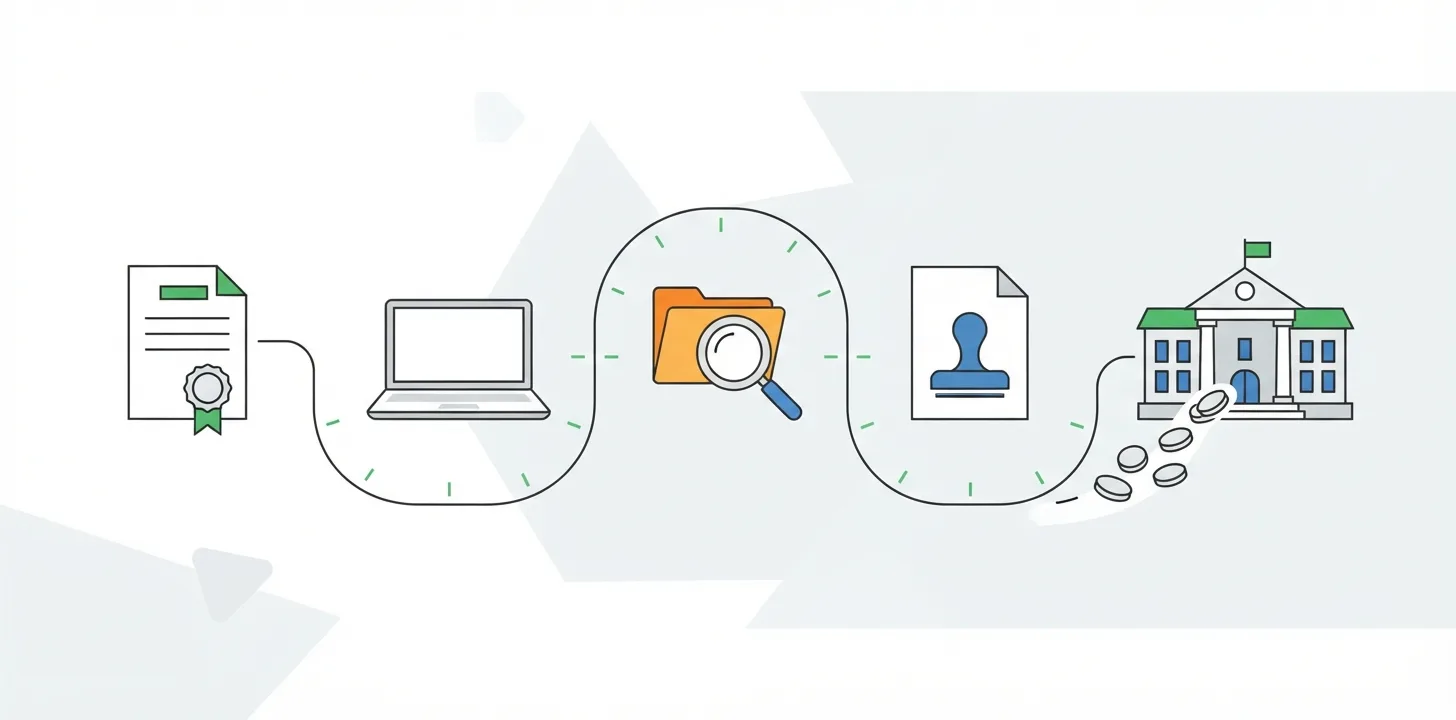
This guide walks the road in order, from the day the admission letter arrives to the day the first payment reaches the college. I have used the government's PM-Vidyalaxmi guidelines, the Indian Banks' Association (IBA) model scheme and the published requirements of several lenders, and I have noted where practice differs from the paperwork.
Background: Who Does What In An Education Loan#
Five parties are involved, and it helps to know their jobs.
You, the student. The borrower. Your admission, marks and course are what the loan is built around.
The co-applicant. Usually a parent or guardian who signs the loan with you and shares responsibility for repaying it. Banks rely heavily on their income and credit history, because you have no salary yet.
The lender. A public or private sector bank, or a registered non-banking finance company (NBFC).
The institution. It supplies your admission proof and fee structure and receives the money.
The portal. For most bank loans in India, the front door is the government's PM-Vidyalaxmi portal, which grew out of the older Vidya Lakshmi portal and lets you apply to several lenders with one form.
Three technical terms will recur. The sanction letter is the bank's written approval, stating the loan amount, rate and conditions. Disbursement is the actual release of money in stages. A moratorium is the repayment holiday during your course and shortly afterwards, during which interest builds up but no EMIs are due.
Step One: Before You Apply, Get Your Facts Straight#
Applications go wrong at the start, usually because of a missing piece of paper or a vague number. Spend a day on this.
Hold a confirmed admission. Banks lend against a seat, not a hope. An admission letter or offer, sometimes with a fee receipt or seat acceptance, is the anchor document. For study abroad, the equivalent is the offer letter, and for the USA an I-20 form, without which most lenders will not proceed.
Build the cost statement. This is a table of what the course will cost you each year: tuition, hostel, mess, books, a laptop, exam fees and, for overseas study, travel and living expenses. Take it from the college's official fee schedule or prospectus. The PM-Vidyalaxmi guidelines explicitly allow fees, hostel and mess charges, a reasonable laptop and reasonable living expenses. A cost statement that matches the institution's own document goes through faster than one you made up.
Choose your route before you choose a bank. The scheme you are eligible for changes the rate and the paperwork. Public sector banks run schemes for premier institutions, for merit admissions to listed Indian institutions and for study abroad. If you are unsure, read a scheme comparison first.
Check the co-applicant's credit health. Ask for a credit report from one of the credit bureaus. Comparison sites commonly quote a minimum score of around 700 for both applicant and co-applicant, though this is a lender preference, not a law. A missed credit card bill from two years ago is far easier to fix before you apply than after a rejection.
Collect your documents. Identity and address proof, academic marksheets, the admission letter, the cost statement, the co-applicant's income proof and bank statements. There is a separate guide for who needs which papers, but the short rule is to gather six months of bank statements and two years of income proof for the co-applicant.
Step Two: Apply Through The Portal Or A Branch#
You have two doors, and the smartest students use both.
The portal route. Register on the PM-Vidyalaxmi portal with your name, email and mobile number, then fill the common education loan application form. You enter your course, institution and the loan amount you need, then choose the banks to send it to. The guidelines describe a "simple 2-page application format". Each bank acknowledges the application, and you can track it with your student or application ID. One bank's product page mentions a small portal charge, so check whether a fee applies to you.
The portal has two advantages. It lets you apply to several lenders at once, and for PM-Vidyalaxmi's collateral-free loans and interest subvention it is the only route. The government reported that 1,12,817 loans worth ₹15,634 crore had been sanctioned through it by 21 July 2026.
The branch route. A visit to the branch nearest your parents' home still matters. The IBA model scheme suggests loans be sanctioned "preferably by the Branch nearest to the place of residence of parents", and it says no application should be rejected without the concurrence of a higher authority. Whether or not every branch follows this in spirit, it gives you a polite line to use if an application is turned down at the counter: "Could this be referred to the next higher authority?"
Apply to at least two lenders. A written sanction from one is leverage with another, and it is the only reliable way to compare total cost.
Step Three: What Happens During Appraisal, And How To Read The Sanction Letter#
Appraisal is the bank's assessment. Expect it to check four things: that your admission is genuine and the course is eligible, that the cost estimate is reasonable, that the co-applicant can support repayment, and, above certain limits, that the security is adequate.
The standard limits come from the IBA model. Up to ₹4 lakh, a parent's co-obligation is enough. Between ₹4 lakh and ₹7.5 lakh, banks have traditionally asked for a third-party guarantee too, though many now waive it. Above ₹7.5 lakh, banks generally want tangible collateral of suitable value. PM-Vidyalaxmi and some premier-institution schemes are exceptions. For collateral, the bank will also verify the property's title and value, and you should expect that to add time. One consultancy summary reports that SBI takes about four to eight weeks for larger overseas loans. Plan on several weeks and not days.
Then comes the sanction letter. Do not sign until you have read these items:
- The amount and how it is staged. Is the limit for the whole course or each year?
- The rate, the benchmark and the spread. For most public sector loans, the rate is a benchmark such as the repo rate plus a fixed spread. The spread is the part that will not change.
- Margin. The share of the cost you must fund yourself, and when you must bring it in.
- Moratorium and repayment period. Typically the course plus one year, with repayment for up to 15 years.
- Fees. Processing, legal, valuation and any insurance premium that has been added to the loan.
- Prepayment terms. Whether you can repay early without a penalty.
- Security and insurance. What is being pledged, and whether life cover is compulsory.
Take a photograph of the letter and keep a copy. If anything differs from what the branch told you verbally, ask for the correction in writing.
Step Four: Disbursement, Or How The Money Actually Moves#
After you accept the sanction, you sign the loan agreement, complete any security formalities and bring in your margin money. Only then does disbursement begin.
Who receives the money. The college, in most cases. Banks ask for the fee demand or challan from the institution and pay it directly. For overseas study, the payment is remitted to the foreign university, usually in the local currency. For some government-linked schemes, the payment route is digital and tracked through the portal, because interest subvention is credited to the loan account later.
When. In stages. The IBA model says the loan is disbursed as per requirement, with margin brought in year by year. For a four-year degree, you will typically submit the fee demand each semester or year, along with your latest marksheet, and the bank releases the next tranche.
Why it matters for cost. Interest is charged on what has been disbursed, not on what has been sanctioned. Drawing in stages therefore saves money. The chart below shows a ₹20 lakh loan at 9.5 per cent, drawn at ₹5 lakh a year over a four-year course, with a year of grace afterwards. If interest is left unpaid, the balance grows to about ₹26.65 lakh by the time your first EMI falls due. If you pay the interest as you go, it stays at ₹20 lakh. The gap between the two lines is the price of the repayment holiday.
Two practical warnings. First, apply early. Fee deadlines are set by colleges, not by banks, and a delay in sanction can leave you paying a late fee or risking your seat. Second, do not pay the fee yourself expecting a reimbursement unless the bank has said in writing that it will reimburse. Direct payment is the norm.
Step Five: After The First Payment, And When Things Stall#
Keep the paper trail. Fee receipts, sanction letter, agreement, disbursement statements. You will need them for tax claims, for subvention and if there is ever a dispute.
Decide on interest servicing. If you can pay even part of the interest during the course, do it. Many lenders offer a rate concession for it.
Claim the subsidy if you qualify. Under PM-Vidyalaxmi, students with family income up to ₹8 lakh may receive 3 per cent interest subvention on loans up to ₹10 lakh during the moratorium, and those with income up to ₹4.5 lakh at technical or professional courses may receive full subvention. Eligible students are informed through the portal and must apply for the benefit there. The subvention is credited only to a live loan account, so keep the account in good standing.
If the application stalls. Ask the branch for the specific reason in writing. The usual culprits are incomplete documents, a weak credit score, an ineligible course, insufficient security, or a co-applicant whose income proof does not match their bank credits. Fix the reason, then reapply, either at the same bank or at a different one. A rejection at one lender is not a verdict from all of them.
Keep the conversation going with the bank. Update the branch when your address, your course or your co-applicant's employment changes. Surprises are what turn manageable loans into difficult ones.
Frequently Asked Questions#
How long does it take to get an education loan?
It varies widely. A small, collateral-free loan with complete documents can move in days or a couple of weeks, while larger or secured loans that need property verification take longer. One consultancy summary reports four to eight weeks for large SBI overseas loans, so apply well before your fee deadline.
Does the bank pay the college directly?
Usually yes. The IBA model scheme says disbursement should be in stages directly to the institution or to vendors of books and equipment wherever possible. For overseas study, the bank remits the fee to the foreign university.
Where do I apply for an education loan in India?
You can apply through the PM-Vidyalaxmi portal, which lets you send one application to several banks, or directly at a bank branch. For PM-Vidyalaxmi's collateral-free loans and interest subvention, the portal is the route.
What is a sanction letter and why does it matter?
It is the bank's written approval, setting out the amount, the interest rate and benchmark, the moratorium, fees, margin and security. It is the only document that counts when comparing offers. Verbal quotes at a counter are not binding.
Can I get an education loan before I have an admission letter?
Banks lend against a confirmed admission, so a full sanction usually needs the admission letter. Some lenders give an in-principle indication early, which helps you plan, but it is not a commitment.
Do I need to bring my own money to the process?
Sometimes. The margin is the share of the cost that you fund yourself. Under the IBA model it is nil up to ₹4 lakh and 5 per cent above that for courses in India, and 15 per cent for study abroad. Many premier-institution and PM-Vidyalaxmi loans carry no margin above ₹7.5 lakh.
What should I do if my education loan is rejected?
Ask for the reason in writing, fix it, and reapply. Common causes include incomplete documents, a low credit score, insufficient security or an ineligible course. You can also apply to another bank, since a rejection at one lender does not bind the others.
Process details were checked on 26 September 2026 against the IBA Model Education Loan Scheme, the Department of Higher Education's PM-Vidyalaxmi guidelines, and published lender requirements. Practice varies by branch and scheme, so confirm the exact steps with your lender.