
Three Different Results Arrive Under One Word#
Candidates say "I cleared NET" as though it were a single outcome. It is not, and the distinction determines whether you receive a fellowship worth several lakh rupees a year or simply a certificate confirming you may apply for teaching posts.
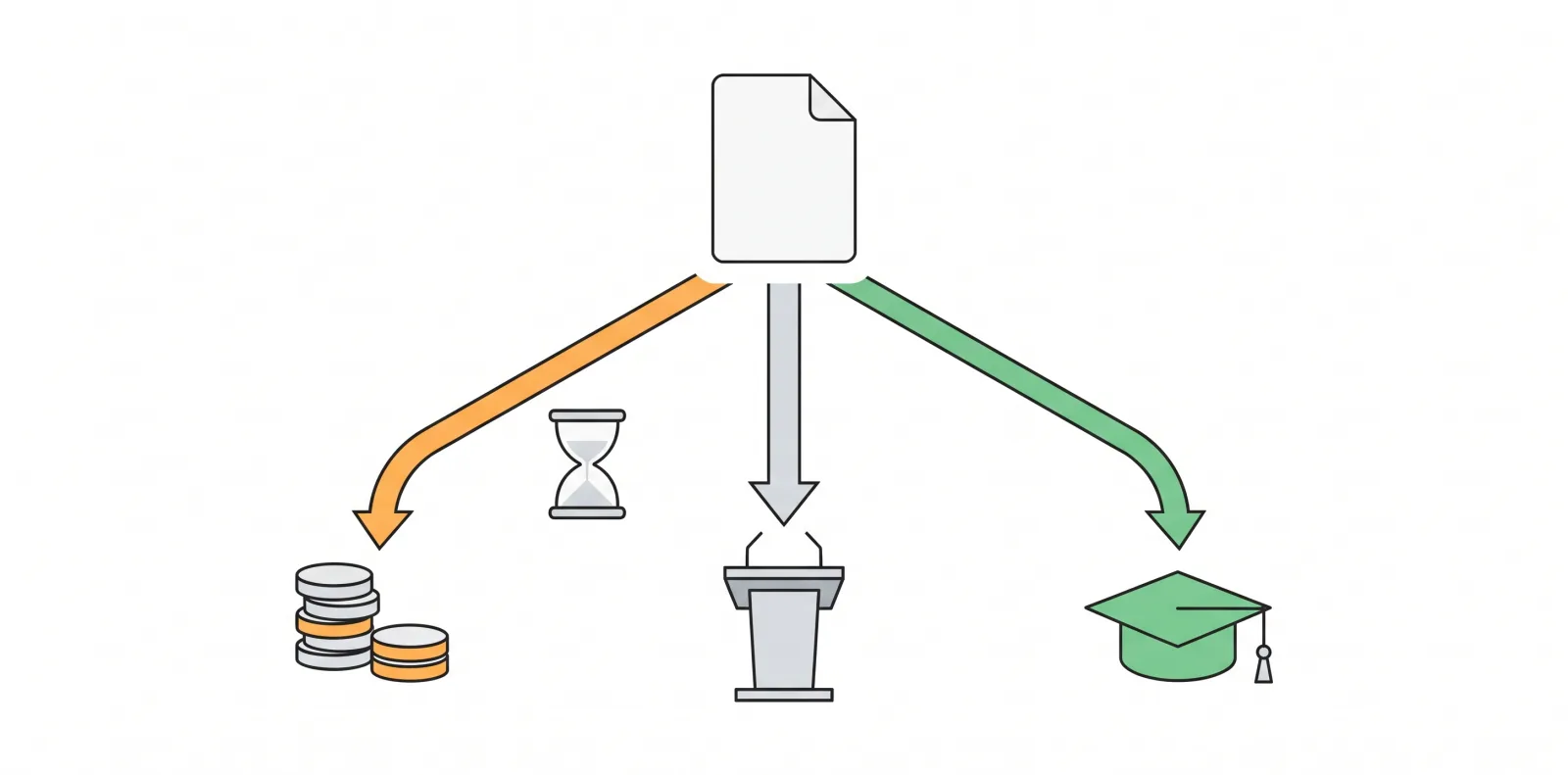
A UGC NET result now produces one of three qualification outcomes. You may qualify for Junior Research Fellowship along with Assistant Professor eligibility, which is the highest outcome. You may qualify for Assistant Professor eligibility only. Or you may qualify for PhD admission only, a category introduced to let institutions use NET scores for doctoral admission without the candidate holding full Assistant Professor eligibility.
These are cut at different thresholds from the same examination. The same paper, the same marks, three different lines.
And the fellowship one carries a deadline that catches people out badly, because a JRF award is not permanent and it does lapse. Here is what each outcome actually means.
Background: What The Examination Determines#
The examination. UGC NET is conducted by the National Testing Agency to determine eligibility for Assistant Professor posts and for the award of Junior Research Fellowship in Indian universities and colleges, and now for doctoral admission.
CSIR NET performs the same function for the science disciplines, covering Chemical Sciences, Earth, Atmospheric, Ocean and Planetary Sciences, Life Sciences, Mathematical Sciences and Physical Sciences. The December 2026 examination is scheduled for 20 and 21 December 2026 in computer-based mode.
One examination, three cut-offs. The merit list is drawn and three separate lines are applied. The JRF line sits highest, Assistant Professor eligibility next, and PhD admission qualification lowest.
Two terms worth defining:
JRF. Junior Research Fellow. A funded research position held while pursuing doctoral work, paid monthly by the awarding body rather than by your university.
SRF. Senior Research Fellow. The upgraded stage a JRF moves to after satisfactory progress evaluation, at a higher stipend.
The Three Outcomes, Compared#
The Money, Stated Plainly#
This is the part worth knowing precisely, because it determines whether doctoral study is financially viable.
JRF stipend. ₹37,000 a month for the first two years.
SRF stipend. ₹42,000 a month for the following three years, awarded after satisfactory evaluation of research progress by your institution.
Contingency grant, paid annually on top of the stipend to cover books, travel, conference attendance and research materials. In Humanities and Social Sciences this is ₹10,000 for a JRF and ₹20,500 for an SRF. In the Sciences it is ₹12,000 for a JRF and ₹25,000 for an SRF.
House rent allowance is payable in addition where institutional accommodation is not provided, subject to the applicable rules.
Total duration. Five years maximum across both stages.
What this means in practice. A funded doctoral researcher receives a monthly income comparable to many entry-level graduate salaries, without tuition liability in most public institutions. That is the difference between a PhD being financially feasible and being a five-year period of dependence. It is the single strongest argument for targeting the JRF threshold rather than settling for Assistant Professor eligibility.
The Age Rules, Which Differ Sharply Between Categories#
For JRF, an age limit applies. The upper limit is 30 years, computed as on a cut-off date specified in the notification.
Relaxation extends this to 35 years for candidates from OBC non-creamy-layer, Scheduled Caste, Scheduled Tribe and Persons with Disability categories, and for women candidates.
For Assistant Professor eligibility, there is no age limit at all. A candidate of any age may qualify and the eligibility holds.
The strategic consequence, and it is significant. A candidate approaching the JRF age ceiling has a closing window for the fellowship and an open-ended one for teaching eligibility. If you are 28 and considering whether to attempt seriously this cycle or next, the fellowship arithmetic is what should decide it, because the teaching eligibility will still be available later and the fellowship will not.
Check the cut-off date carefully. Age is assessed as on a date stated in the notification, not as on the examination date. Candidates within the limit on examination day but over it on the specified date are assessed as over-age, and this surfaces at verification.
The Deadline That Causes Fellowships To Lapse#
This is the provision that costs people the money they earned, and it is poorly publicised.
A JRF award is not held indefinitely. To avail the fellowship you must enrol in a recognised doctoral programme within a defined window after your result is declared, commonly cited as two to three years. Miss that window and the award lapses. It cannot be reclaimed, revived or deferred further.
Why candidates miss it. They qualify, take a teaching post or another job intending to start doctoral work later, and the window closes while they are busy. Or they apply to doctoral programmes, are unsuccessful in the first cycle, and do not reapply promptly.
What to do about it. Treat the qualification date as the start of a clock. Identify target institutions and supervisors immediately. Apply in the first admission cycle after qualifying rather than the second. If you intend to work first, understand precisely what you are giving up, because the sum across five years is substantial.
Assistant Professor eligibility behaves completely differently. It has lifetime validity. Once you have it, it does not expire, and you may use it to apply for teaching posts at any point in your career. This asymmetry between the two qualifications is the most important practical distinction on your scorecard.
What Each Outcome Actually Opens#
With JRF. Funded doctoral study at institutions that accept the fellowship, plus full Assistant Professor eligibility for teaching applications, plus the standing that a competitive fellowship carries in academic applications later.
With Assistant Professor eligibility only. The right to apply for teaching posts in universities and colleges. You may still pursue a doctorate, funded through an institutional fellowship, a project position, a different national fellowship, or self-funding. Many excellent researchers took this route.
With PhD admission qualification only. Admission to doctoral programmes at institutions that accept NET scores for that purpose. It does not confer Assistant Professor eligibility, which means you would need to qualify again at the higher threshold to apply for teaching posts.
And a point about reattempting. Candidates who qualify for Assistant Professor but miss JRF frequently reattempt for the fellowship, and this is entirely rational while you are within the age window. Your existing Assistant Professor eligibility is not lost by attempting again.
What To Do If You Miss The JRF Line#
Most candidates who qualify do so below the fellowship threshold, and the question of what happens next deserves a proper answer rather than disappointment.
First, establish exactly what you hold. Assistant Professor eligibility has lifetime validity and no age limit. PhD admission qualification has a shorter validity for admission purposes. These are different assets with different expiry behaviour, and the distinction determines your next move.
If you are within the JRF age window, reattempting is usually rational. The ceiling is thirty, extended to thirty-five for reserved categories, Persons with Disability candidates and women. Your existing Assistant Professor eligibility is unaffected by attempting again, so the downside is preparation time rather than risk. Given that the fellowship is worth ₹37,000 a month rising to ₹42,000 across up to five years, the arithmetic strongly favours another attempt while you remain eligible.
If you are outside the window, the doctorate is still entirely available. Funding comes from institutional fellowships, project positions attached to funded research, other national schemes, university-specific assistantships, or self-funding. A substantial number of researchers took one of these routes, and none of them makes your doctorate less valid.
Use Assistant Professor eligibility now if teaching interests you. It permits applications to university and college posts, it does not expire, and holding a teaching post while pursuing doctoral work part-time is a common and workable path in many disciplines.
And address the specific reason you fell short. Was it Paper 1, where several units are easily secured with a few focused hours, or Paper 2, where the gap is usually untouched syllabus units? The diagnosis determines whether a reattempt needs a month of targeted work or a full preparation cycle.
What Happens To The Fellowship Once You Start#
The award does not simply arrive and continue. It is administered, reviewed and occasionally interrupted, and knowing the mechanics prevents unpleasant surprises.
Disbursal runs through your institution. The fellowship is released to the university or institute, which pays you. Delays at the institutional level are common and are usually administrative rather than a problem with your award.
The upgrade to Senior Research Fellow is not automatic. It follows a review of your research progress, typically involving a presentation and an assessment by a committee at your institution. Satisfactory progress moves you from ₹37,000 to ₹42,000 a month; unsatisfactory progress can delay the upgrade.
The contingency grant must be claimed. It is not paid with your stipend. You claim it against actual expenditure on books, travel, conference attendance and research materials, with receipts, through your institution's process. Fellows routinely underclaim it simply by not submitting.
Leave provisions exist and are defined. Annual leave, medical leave and maternity provisions are specified in the fellowship terms. Extended absence beyond the provisions requires approval.
The five-year maximum is a ceiling, not an entitlement. It covers two years as a Junior Research Fellow and three as a Senior Research Fellow. A doctorate running longer than five years continues without fellowship support, which is worth factoring into your planning from the outset.
And you cannot normally hold another fellowship or a salaried position simultaneously. The terms restrict concurrent emoluments, so a fellow taking paid teaching work should check what is permitted before accepting it.
Frequently Asked Questions#
What is the difference between JRF and Assistant Professor eligibility?#
JRF is a funded research fellowship awarded at the highest cut-off, and it also confers Assistant Professor eligibility. Assistant Professor eligibility alone is awarded at a lower cut-off, carries no funding, and permits you to apply for teaching posts.
How much does a JRF pay?#
₹37,000 a month for the first two years, rising to ₹42,000 a month as a Senior Research Fellow for the following three years after a satisfactory progress evaluation, plus an annual contingency grant and house rent allowance where applicable.
What is the age limit for JRF?#
Thirty years as on the cut-off date specified in the notification, extended to thirty-five for OBC non-creamy-layer, Scheduled Caste, Scheduled Tribe and Persons with Disability candidates and for women. There is no age limit for Assistant Professor eligibility.
Does a JRF award expire?#
Yes. You must enrol in a recognised doctoral programme within a defined window after the result, commonly cited as two to three years. If the deadline passes, the award lapses and cannot be reclaimed.
Does Assistant Professor eligibility expire?#
No. It has lifetime validity and may be used to apply for teaching posts at any point in your career.
What is the PhD-admission-only category?#
A qualification outcome at the lowest of the three cut-offs, permitting doctoral admission at institutions that accept NET scores for that purpose. It does not confer Assistant Professor eligibility.
Should I reattempt if I qualified for Assistant Professor but not JRF?#
While you remain within the JRF age window, usually yes. The financial difference across five years is substantial and your existing Assistant Professor eligibility is not affected by attempting again.
Where should I confirm stipend amounts and rules?#
With the University Grants Commission and the awarding body, which publish the fellowship provisions, and with the NTA notification for age cut-off dates. Stipend rates and contingency amounts are revised periodically.