
Your Subject Decides Most Of This For You, And Candidates Do Not Realise It#
A common question in postgraduate corridors: should I take UGC NET or CSIR NET?
For most candidates the question does not arise, because the answer is fixed by their discipline. CSIR NET covers five science subjects and UGC NET covers everything else. A sociologist cannot sit CSIR NET. A physicist does not sit UGC NET for Physics, because Physical Sciences sits under CSIR NET.
Where genuine choice exists is narrower than people assume, and it usually concerns candidates in interdisciplinary areas or those whose postgraduate subject maps plausibly onto more than one NET subject code.
The larger and more useful question is different: given your discipline and what you want to do afterwards, which of these four examinations serves you, and are any of them worth attempting together?
Here is that mapping.
Background: What Each Examination Is#
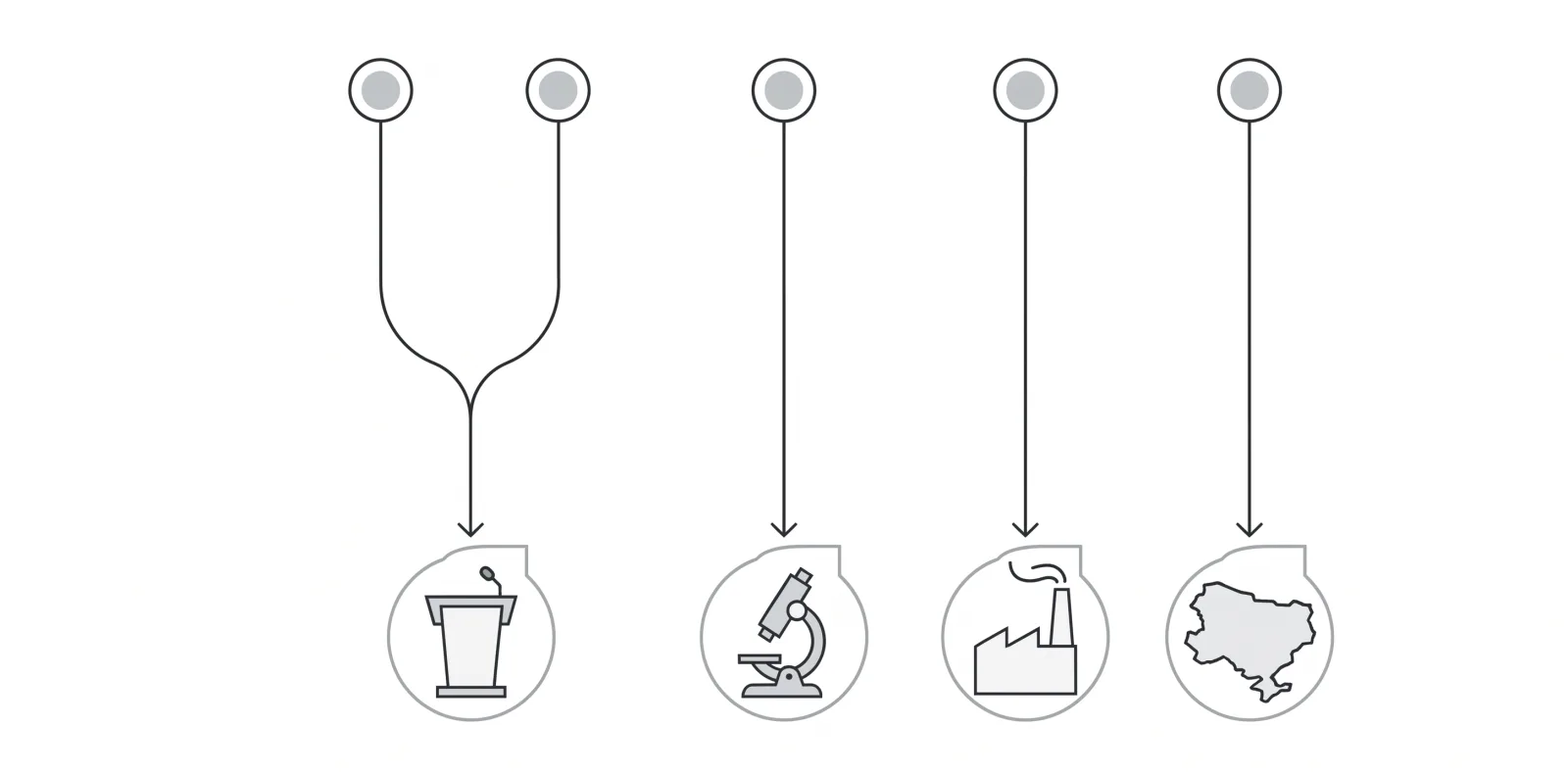
UGC NET. Conducted by NTA, covering a broad subject list now standing at 87 following the addition of Statistics and Forestry. Determines eligibility for Assistant Professor posts, for the award of Junior Research Fellowship, and for doctoral admission. December 2026 runs from 14 to 19 December with buffer dates following.
CSIR NET. Conducted by NTA for five science disciplines: Chemical Sciences; Earth, Atmospheric, Ocean and Planetary Sciences; Life Sciences; Mathematical Sciences; and Physical Sciences. Same three outcomes as UGC NET. December 2026 falls on 20 and 21 December.
GATE. Conducted by the IISc and IITs, covering engineering, science, humanities and related disciplines across 30 papers in the 2027 cycle. Feeds postgraduate admission, public sector recruitment and the assistantship that funds most postgraduate students. GATE 2027 runs across six days in February 2027.
SET. State Eligibility Test, conducted by individual states or by designated agencies on their behalf, determining Assistant Professor eligibility within that state.
Two terms worth defining:
Eligibility versus recruitment. None of these four is a recruitment. Each establishes that you meet a standard. The job or the admission comes from a separate process you must apply to.
Subject code mapping. Your postgraduate subject must map to an available subject code under the relevant examination's eligibility rules. This is where interdisciplinary candidates encounter difficulty, and it should be checked before planning anything.
The Four, Mapped#
Reading The Map#
UGC NET and CSIR NET are the same instrument for different disciplines. Both produce three qualification outcomes: fellowship with teaching eligibility, teaching eligibility alone, or doctoral admission eligibility alone. Which one you sit is determined by your subject, not by preference.
The one structural difference worth knowing. UGC NET has no negative marking, so you should answer every question. CSIR NET does have negative marking, varying by part and subject. Candidates who move between the two carry the wrong instinct across and lose marks.
GATE is a different kind of instrument. It does not confer teaching eligibility. What it does is open postgraduate admission, unlock the assistantship that funds most postgraduate study, and serve as the shortlisting mechanism for graduate engineer recruitment at a substantial group of public sector undertakings. Its three-year validity means one attempt serves multiple cycles.
SET is geographically bounded. It establishes Assistant Professor eligibility within the state that conducts it. For a candidate who intends to teach in their home state and has no plans to move, it is a legitimate and less contested route. For anyone who might work elsewhere, it is a limited instrument, and NET is the portable one.
Which Combinations Are Worth Attempting Together#
NET and SET. Yes, if you intend to teach and have a home state preference. They test broadly comparable material, SET is less contested, and holding both gives you national portability plus a stronger position within your state. The marginal preparation cost is small.
GATE and CSIR NET, for science candidates. Worth considering, because they open genuinely different doors. GATE opens funded postgraduate study and public sector recruitment; CSIR NET opens the research fellowship and teaching eligibility. The syllabus overlap in mathematical and physical sciences is meaningful, though GATE's engineering orientation differs from CSIR NET's research orientation.
GATE and UGC NET. Rarely useful together, because they serve different populations. An engineering graduate heading towards industry or postgraduate study wants GATE. A humanities or social science postgraduate heading towards academia wants UGC NET. The overlap is thin.
UGC NET and CSIR NET together. Generally not possible, since your subject determines which one you are eligible for. Candidates in genuinely interdisciplinary areas should check subject code mapping carefully before assuming either.
The general principle. Attempt a second examination when it opens a materially different outcome and the marginal preparation cost is low. Attempt it for neither of those reasons and you have split your effort for nothing.
Choosing By Career Intention Rather Than By Discipline Alone#
Work backwards from what you want.
If you want to teach at a university or college. UGC NET or CSIR NET according to your subject, with SET as an additional route if you have a state preference. GATE does not help here.
If you want a funded doctorate. UGC NET or CSIR NET at the JRF threshold, which pays ₹37,000 a month rising to ₹42,000. Aim for that line specifically rather than settling for teaching eligibility, and note the age limit, which is thirty with relaxations, unlike teaching eligibility which has none.
If you want a postgraduate degree in engineering or technology. GATE, and note that the qualifying score is far below what admission to a good programme requires.
If you want a public sector job as an engineer. GATE, targeting a score well above the qualifying mark, since the employer cut-offs sit substantially higher.
If you are not yet sure. Take the examination your discipline points to, at the highest threshold you can reach. All of these qualifications have value beyond their primary purpose, and none of them expires quickly except the JRF enrolment window and the NET score's doctoral admission validity.
And a note on sequencing. Assistant Professor eligibility has lifetime validity and no age limit. The JRF has an age ceiling. If both are available to you, the fellowship is the time-bound opportunity and should be pursued first.
Age Limits, Validity And Why Sequencing Matters#
The four examinations behave very differently over time, and understanding that determines the order in which you should attempt them.
Assistant Professor eligibility does not expire and has no age limit. Whether obtained through UGC NET, CSIR NET or a State Eligibility Test, it remains available for the rest of your career. This is the least urgent of the qualifications.
The research fellowship is time-bound. The JRF age ceiling is thirty, extended to thirty-five for reserved categories, Persons with Disability candidates and women. Once that window closes it does not reopen, and the fellowship is worth ₹37,000 a month rising to ₹42,000 across up to five years.
The NET score's doctoral admission validity is short. Commonly cited as one year for admission purposes, which is a different clock again from both the fellowship enrolment deadline and the lifetime teaching eligibility.
A GATE score lasts three years. Long enough to serve postgraduate admission in one cycle and public sector recruitment in another, which makes a single strong attempt unusually efficient.
The sequencing conclusion. Pursue the time-bound opportunities first. If you are within the JRF age window, that attempt is the urgent one, because teaching eligibility will still be available at forty and the fellowship will not. If you are an engineering graduate, GATE early gives you three years of optionality across admission and recruitment.
And check every age cut-off date carefully. Ages are assessed as on a date specified in the notification, not as on the examination date. Candidates within the limit on examination day but over it on the specified date are assessed as over-age, and this surfaces at verification rather than at application.
Preparation Overlap, And What Transfers Between Them#
Before deciding to attempt two of these, work out honestly how much of the effort is shared.
UGC NET and SET overlap almost completely. Both examine general teaching and research aptitude alongside a subject paper, and the subject syllabuses are broadly comparable. Preparing for one prepares you for the other, with the main differences being state-specific administrative details and the particular emphasis a state agency applies. This is the cheapest second attempt available to anyone.
CSIR NET and GATE overlap partially for science candidates. In mathematical and physical sciences the underlying content is substantially shared, though the orientation differs: GATE leans towards applied and engineering framing while CSIR NET leans towards research framing and experimental reasoning. A candidate preparing one is perhaps sixty per cent prepared for the other, with the remaining work being format and emphasis.
UGC NET and GATE overlap very little. They serve different disciplines and different outcomes. Attempting both is rarely efficient.
The aptitude sections differ more than candidates expect. UGC NET Paper 1 covers teaching and research aptitude across ten specified units. CSIR NET Part A covers general reasoning and numerical ability. These are not interchangeable, and each needs its own preparation.
The decisive question before adding a second examination. Does it open an outcome the first does not, and is the additional preparation under roughly a month? If both answers are yes, add it. If either is no, put the time into the first examination instead.
Frequently Asked Questions#
Can I choose between UGC NET and CSIR NET?#
Usually not. CSIR NET covers five science disciplines and UGC NET covers the remaining subjects. Your postgraduate subject determines which you are eligible for. Genuine choice arises mainly for interdisciplinary candidates, who should check subject code mapping carefully.
What is the main structural difference between them?#
UGC NET has no negative marking, so every question should be attempted. CSIR NET applies negative marking that varies by part and subject. Candidates moving between them frequently carry the wrong attempt strategy across.
Does GATE give teaching eligibility?#
No. GATE opens postgraduate admission, unlocks the assistantship that funds most postgraduate study, and serves as the shortlisting mechanism for public sector engineer recruitment. Teaching eligibility comes from NET or SET.
What is SET and how does it differ from NET?#
The State Eligibility Test, conducted by individual states, establishing Assistant Professor eligibility within that state only. NET is nationally portable. SET is typically less contested, which makes it a sensible addition for candidates with a settled state preference.
Is it worth sitting both NET and SET?#
For candidates who intend to teach and have a home state preference, generally yes. The material overlaps substantially, so the marginal preparation cost is low, and holding both provides national portability plus a stronger state position.
Should a science postgraduate take GATE as well as CSIR NET?#
Often worth considering, since they open different outcomes: GATE for funded postgraduate study and public sector recruitment, CSIR NET for the research fellowship and teaching eligibility. Syllabus overlap in mathematical and physical sciences makes the addition manageable.
Which examination should I prioritise if I want a funded PhD?#
UGC NET or CSIR NET at the JRF threshold, which carries a stipend of ₹37,000 a month rising to ₹42,000. Note the age ceiling of thirty with relaxations, since unlike teaching eligibility this opportunity is time-bound.
Where do I confirm my eligibility?#
In each examination's current information bulletin, which specifies subject lists, subject code mapping and qualification requirements. Check before planning, particularly if your postgraduate subject sits across disciplinary boundaries.