The Year Everyone Tells You To Sacrifice Something#
Two pieces of advice circulate every Class 12 year, and both are wrong.
The first says boards do not matter, so ignore them and focus on the entrance examination. This ignores that board marks are an eligibility requirement for several admission processes, that many universities and state admission systems use them directly, that they appear on your record permanently, and that a poor Class 12 record limits options for years, including at management school admission almost a decade later.
The second says do both fully, with equal intensity, all year. This ignores arithmetic. There are only so many hours, and a student attempting two separate full preparations usually delivers two mediocre ones.
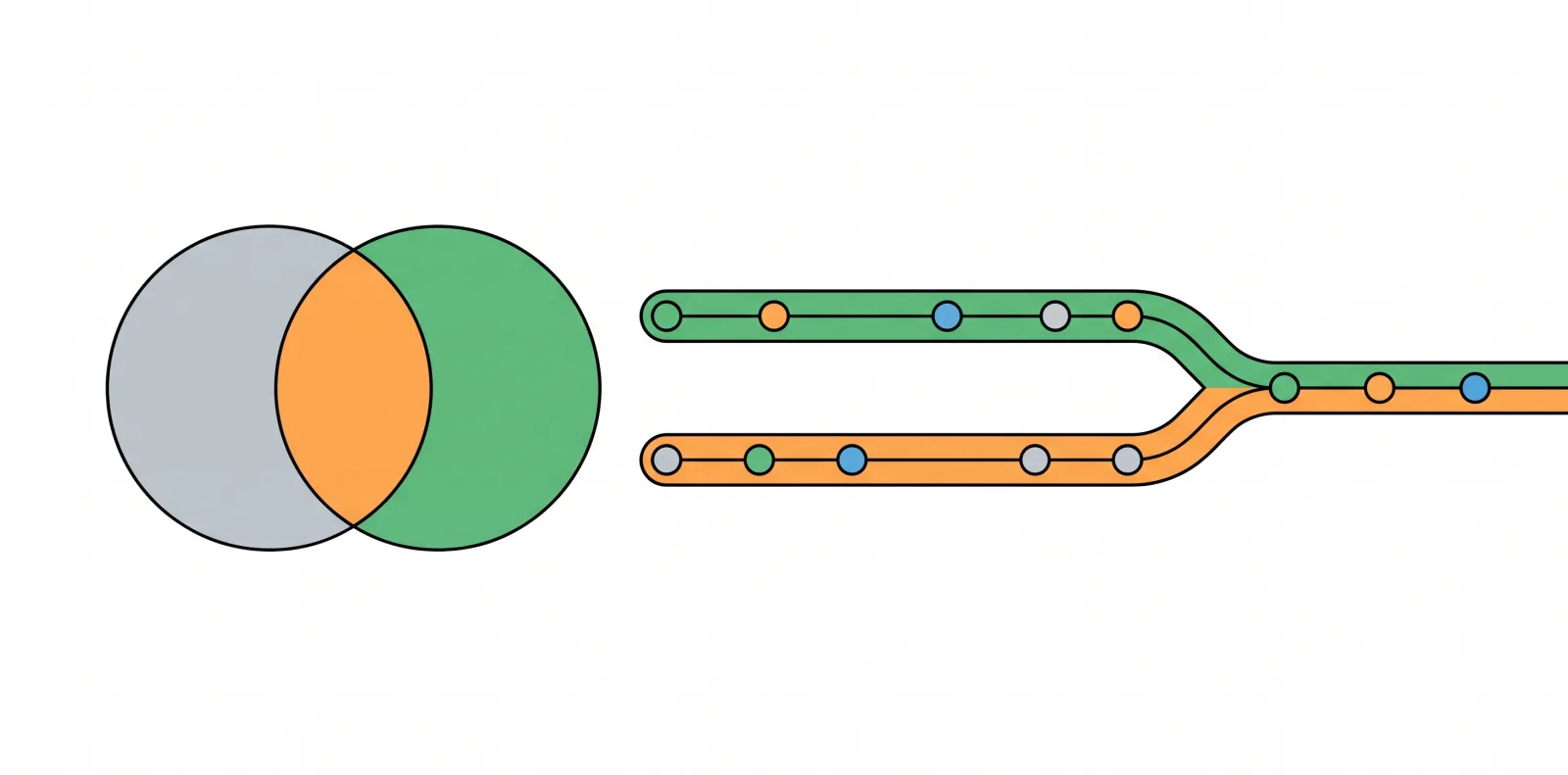
The correct approach is neither. It is to recognise that these examinations share most of their content and differ mainly in how they ask questions, and to build one plan that exploits the overlap deliberately.
Here is that plan, month by month.
Background: Where The Overlap Is, And Where It Is Not#
Start by understanding exactly how much is shared, because this determines everything.
The syllabus overlap is large. JEE and NEET draw heavily on NCERT content for Classes 11 and 12, which is the same content CBSE examines and which most state boards cover in substantially similar form. CUET's domain subject papers are likewise built around the same foundation. You are not studying two syllabi. You are studying one, with additions.
The question style differs sharply, and this is the real gap.
Board questions are typically direct. They ask you to state, derive, explain, draw or solve within a familiar framework. Marks are awarded stepwise, so a partially correct answer earns partial marks. Presentation matters, and so does writing the intermediate steps.
Entrance questions are typically multiple choice, often combining two or three concepts in one problem, frequently designed so that a plausible-looking wrong answer matches a common error. There are no partial marks, and in several papers a wrong answer costs you marks. Speed is a first-order consideration rather than a secondary one.
The extra content is real but bounded. JEE in particular includes topics and depths beyond board requirements, and its problem difficulty exceeds board level considerably. NEET stays closer to NCERT content but demands very high accuracy across a huge volume of factual biology.
The practical implication. For roughly seventy per cent of your work, studying for one is studying for the other. The remaining thirty per cent is the specific skill of each format, and that is what needs separate, deliberate practice.
The Overlap Strategy, In One Paragraph#
Learn concepts once, properly, from NCERT. Then practise them twice: once by writing full stepwise answers as a board paper demands, and once by solving multiple-choice problems under time as the entrance demands. The learning is shared. Only the practice is duplicated, and the duplication is the point, because each format trains something the other does not.
The Month-By-Month Calendar#
This assumes a typical Indian academic year beginning in April, with boards in the February to April window, JEE sessions in January and April, NEET in early May and CUET in May. Exact dates shift each year and differ by board, so confirm against official notifications and adjust the shape of this plan accordingly.
| Period | Primary focus | Board work | Entrance work | The thing students get wrong |
|---|---|---|---|---|
| April to June | Build the Class 12 foundation | Stay current with school teaching. Complete NCERT chapters as they are taught, including exercises | Solve entrance-level problems on each chapter immediately after learning it, while it is fresh | Treating these months as a warm-up. This is the cheapest learning time in the whole year and it is routinely wasted |
| July to August | Deepen and revise Class 11 | Continue with school pace. Begin maintaining a formula and reaction sheet | Revise Class 11 content, which carries substantial weight in JEE and NEET and fades quickly. Start full-length entrance mocks monthly | Ignoring Class 11 until December, by which time it needs relearning rather than revision |
| September to October | Complete the syllabus and diagnose | Take school tests seriously, as diagnostic tools rather than obligations | Increase mocks to fortnightly. Begin an error log categorising every mistake | Solving mocks without analysing them. The analysis is where the marks come from |
| November | The pivot month | Begin dedicated board-format practice. Write full answers by hand, timed | Maintain weekly mocks to keep the skill alive, but reduce new problem volume | Abandoning entrance practice entirely. Four months without it is very hard to recover |
| December | Board-weighted, entrance-maintained | Solve board sample papers and previous year papers. Study marking schemes properly | Two mocks a month, plus daily revision of formulae and high-yield facts | Panicking about how much remains and switching plans repeatedly |
| January | Board practicals and the first entrance session | Complete practical files, revise viva material, do not leave practicals to the last week | If sitting a January entrance session, take it seriously as a real attempt and as calibration | Under-preparing for practicals, which carry meaningful marks and are comparatively easy to secure |
| February to March | Boards, almost exclusively | Full focus. Use the gaps between papers for the next subject only | Maintain a daily thirty to forty-five minute slot of entrance problems so the skill does not decay | Doing zero entrance work for six weeks and then finding the format alien in April |
| Late March to April | The switch back | Boards concluding. Stop board work as each paper finishes | Full-intensity entrance revision. Daily full-length mocks in the final two weeks | Taking a long break after boards. A week off is recovery. Three weeks is a problem |
| May | Entrance examinations | None | NEET, CUET and advanced-level entrance papers land here. Revise from your error log, not from new material | Attempting new topics in the final fortnight |
| June onwards | Counselling | Collect documents | Register for every counselling process you are eligible for, on time | Assuming the examination was the finish line. It was the qualifying round |
The Gaps Between Board Papers: The Most Misused Days Of The Year#
Board timetables leave gaps of two to five days between papers. What you do with them determines a substantial share of your final board marks, and students handle them badly in two opposite ways.
The first error is resting. Three free days feel like a reward after a paper. They are not free days, they are the entire preparation window for the next subject.
The second error is starting fresh. Some students use the gap to attempt topics they never studied. This rarely works and reliably produces panic.
What actually works. Treat the gap as pure revision for the immediate next paper. Revise from your own notes and error log, solve one previous year paper of that subject, review its marking scheme, and revise formulae or key material the evening before. Sleep normally, because sleep deprivation across a six-week examination period degrades performance measurably and compounds.
And do not discuss the paper you have just written. The post-paper conversation in which everyone compares answers has never once helped anybody, and it regularly damages the next paper.
Managing The Two Formats Without Losing Either#
Three practical techniques.
Keep a daily minimum for whichever is not your current priority. Thirty minutes is enough to keep a skill alive. During the board-focused weeks, thirty to forty-five minutes of multiple-choice problems daily preserves your entrance reflexes. During entrance-focused weeks, writing two full board-style answers weekly preserves your writing speed and structure.
Practise the switch explicitly. In the week before you change primary focus, deliberately alternate formats day by day. The cognitive shift between writing a derivation with full steps and solving twenty multiple-choice problems in twenty minutes is real, and practising it removes the disorientation.
Maintain one error log for both. A conceptual gap is a conceptual gap regardless of which examination revealed it. One document, organised by subject and chapter, with a note of where the error showed up. This becomes your final-week revision material and is more valuable than any textbook by April.
Things That Cost Students Marks Every Single Year#
Neglecting practicals. Practical examinations and internal assessment carry real marks and are among the most reliably securable ones available. Complete files on time, learn the viva material, and do not treat them as a formality.
Ignoring the language paper. Students focused on science subjects frequently leave English or their second language entirely unprepared. It is a full paper with full marks and it drags an aggregate down substantially.
Missing registration deadlines. Entrance examination registration windows, correction windows, admit card downloads, photograph specifications. These have hard deadlines and no sympathy. Build a calendar in April and check it weekly.
Sleeping badly for months. Chronic short sleep reduces retention and reaction speed. The hours gained are worth less than the capacity lost. This is not motivational advice, it is how memory consolidation works.
Carrying coaching material that duplicates NCERT. Many students accumulate several parallel resources for the same topic and end up covering none properly. Pick one primary source per subject, use NCERT as the spine, and add a single problem book. Volume of material is not preparation.
Doing no counselling research until results arrive. By then you are making large decisions under time pressure with no information. Read about counselling processes in December, when it costs you an afternoon.
Frequently Asked Questions#
Do board marks actually matter if I am targeting JEE or NEET?#
Yes. They set eligibility thresholds for several admission processes, they are used directly by some state and university admissions, they appear on your permanent record, and they are weighed in later selections including management school admission. Treating them as irrelevant is a mistake that surfaces years later.
How should I split time between boards and entrance preparation?#
Vary it by month rather than fixing a ratio. Entrance-weighted from April to October, balanced in November and December, board-weighted through February and March, entrance-weighted again in April and May. The key rule is never dropping either to zero.
Is NCERT enough for JEE and NEET?#
For NEET, NCERT is the central resource, particularly for biology, and it must be known thoroughly. For JEE, NCERT provides the conceptual foundation but the problem difficulty is well beyond it, so a dedicated problem book is necessary alongside.
What should I do in the gap days between board papers?#
Revise only the subject of the next paper. Solve one previous year paper of it, review the marking scheme, revise formulae the evening before, and sleep normally. Do not start new topics and do not discuss the paper you just wrote.
How many mock tests should I take?#
Build up gradually: monthly early in the year, fortnightly from around September, weekly through the board period, and daily in the final fortnight before the entrance examination. Crucially, analyse every one, because an unanalysed mock is just a way of feeling busy.
Should I take a break after board examinations?#
About a week, yes, and you will need it. Longer than that is a genuine risk, since the entrance examinations follow within weeks and both momentum and format familiarity decay quickly.
How do I prepare for CUET alongside boards?#
CUET's domain papers are largely built on the same NCERT foundation, so the content overlap is substantial. The distinct work is the General Aptitude and language papers, which are frequently underprepared and are an efficient place to gain a percentile advantage. Allocate a few hours a week to them from December.
Where do I check exact dates?#
On the official sites: your board for the examination timetable, the National Testing Agency for JEE Main, NEET and CUET, and the conducting institute for JEE Advanced. Dates shift between years, so verify rather than assuming, and note the registration windows as carefully as the examination dates.