
Most Seats Are Lost To A Calendar, Not To A Rank#
Every July, a predictable tragedy plays out across India. A student with a perfectly workable rank ends up with nothing, not because they were outcompeted, but because they did not register for a counselling process they had never heard of. Or they registered and skipped a document verification date. Or they assumed that clearing the examination was the admission, and that somebody would contact them.
Nobody contacts you. The examination gets you a number. The counselling gets you a seat, and counselling is an entirely separate administrative process with its own registration, its own fee, its own deadlines and its own unforgiving rules.
Worse, there is not one counselling process. There are several, running in parallel, overlapping in time, governed by different authorities, with different eligibility rules. A single student may be eligible for three of them simultaneously and need to make decisions in one that affect their options in another.
This article maps the whole landscape. Read it before results day, not after.
Background: Why India Has Five Admission Systems Instead Of One#
The structure looks chaotic because it grew rather than being designed. Understanding the logic makes it navigable.
Indian higher education is split between institutions funded and governed by the central government and those funded and governed by state governments, with private and deemed institutions layered on top. Each level built its own admission machinery for its own institutions, at different times, for different reasons.
Some vocabulary first, because counselling has a dialect.
Counselling. The process of allotting seats to candidates based on rank, preference and category. It is not advice. Nobody counsels you about anything. It is seat allocation.
Choice filling. Submitting an ordered list of the institution and branch combinations you want. The order is binding, and it is the single most consequential thing you will do in the entire process.
Seat allotment. The system matches candidates to seats by running down the rank list and assigning each candidate their highest available preference.
Float, slide and freeze. After an allotment, you choose what happens in the next round. Freeze means you accept the seat and withdraw from further consideration. Slide means you keep this institution but remain in contention for a better branch within it. Float means you remain in contention for any better preference anywhere, including a different institution.
Domicile. Proof that you belong to a particular state, usually through residence, schooling or a parent's employment. It unlocks the state quota, which is where the large majority of state-college seats live.
Home state and other state quota. In the NIT system, roughly half the seats in each institute are reserved for candidates domiciled in the state where the institute is located, with the remainder open to candidates from elsewhere. This is why an NIT can be far easier to enter from inside its own state than from outside it.
Route One: JoSAA, For IITs, NITs, IIITs And GFTIs#
The Joint Seat Allocation Authority runs a single unified counselling process covering the Indian Institutes of Technology, the National Institutes of Technology, the Indian Institutes of Information Technology and a set of Government Funded Technical Institutes.
Who is eligible. For IIT seats, you need a rank in JEE Advanced, which itself requires qualifying in JEE Main first. For NIT, IIIT and GFTI seats, you need a JEE Main rank. One registration covers both, and you fill a single combined preference list that can mix IIT and NIT choices freely.
How it works. You register on the JoSAA portal, fill and lock your choices, and the system runs a sequence of allotment rounds, typically five or six. In each round you are allotted your highest available preference, and you then pay a seat acceptance fee, complete online document verification, and choose freeze, float or slide before the next round runs.
Where students go wrong. Three mistakes dominate. Filling too few choices, which means the system runs out of options for you and allots nothing. Ordering choices by expected cut-off rather than by genuine preference, which is exactly backwards, since the algorithm already handles feasibility and your job is only to state what you actually want most. And freezing too early out of relief, which permanently closes better options that a later round might have opened.
The one rule worth memorising. Fill your choices in the order you genuinely want them, from most desired to least, including options you think are out of reach. You cannot be harmed by listing an ambitious choice above a realistic one. You can only be harmed by leaving it out.
Route Two: CSAB, For The Seats Left Over#
The Central Seat Allocation Board runs special rounds after JoSAA concludes, filling seats that remained vacant or were vacated when candidates withdrew.
Who should care. Anyone with a JEE Main rank who did not get a seat through JoSAA, and anyone who got one but wants to try for something better. CSAB requires fresh registration. Your JoSAA participation does not carry over automatically.
Why this matters more than it sounds. Vacancies arise in significant numbers because students who hold multiple offers withdraw from one. A student who missed an NIT branch in JoSAA can frequently secure it in a CSAB round at a rank that would have been insufficient earlier. This is the single most underused opportunity in Indian engineering admissions, and it is underused because students stop paying attention once JoSAA ends.
Special categories. CSAB also administers dedicated rounds for candidates from the North Eastern states and Union Territories, under a scheme designed to widen access from regions with fewer technical institutions. Eligibility rules are specific, so read the current brochure carefully if this applies to you.
Route Three: State Counselling, Where Most Engineering Seats Actually Are#
This is the largest route by seat volume and the least discussed in national conversation.
Every state runs its own counselling for its government and private engineering colleges. Some use JEE Main ranks. Many run their own common entrance tests: Maharashtra's MHT-CET, Karnataka's KCET, West Bengal's WBJEE, Tamil Nadu's engineering admission process, the Andhra Pradesh and Telangana EAPCET examinations, Kerala's KEAM, and equivalents elsewhere.
Who should care. Almost everyone taking engineering admission. Even students targeting IITs and NITs should register for their state process as insurance, because it costs little and covers the scenario where the national routes do not deliver.
The domicile point. State quota seats require domicile proof, and the requirements are specific: continuous residence for a stated period, or schooling within the state, or a parent's government employment there. Gather these documents months in advance. Students lose state-quota seats every year because a certificate took three weeks to obtain and the verification window was five days.
Management and NRI quota. Private colleges within state counselling often reserve a proportion of seats for management and NRI admission at substantially higher fees. These are legitimate and regulated, but read the total four-year cost carefully before committing, and be wary of any college asking for payments outside the published fee structure.
Route Four: MCC And State Counselling For Medical Admission#
Medical admission runs on entirely separate machinery, and mixing it up with engineering counselling causes real harm.
NEET UG is the single entrance examination for MBBS, BDS and allied courses nationwide. Seats are then divided. The Medical Counselling Committee conducts counselling for the All India Quota, which covers a fixed proportion of government medical college seats, along with seats at central institutions, deemed universities and certain other categories. The remaining government college seats, the larger share, are filled through each state's own counselling under its state quota, requiring domicile.
The practical consequence. A NEET candidate typically needs to register for two processes simultaneously: the national MCC process and their own state's process. Missing either halves your chances. The rounds interleave, and a decision to accept a seat in one process can carry penalties or forfeiture rules in the other.
Read the penalty clauses. Medical counselling has stricter rules than engineering counselling about resigning an allotted seat, including forfeiture of security deposits and in some rounds debarment from subsequent rounds. These rules change between cycles. Read the current information bulletin rather than relying on what a senior told you about last year.
Route Five: CUET, For University Undergraduate Programmes#
CUET UG is the route into undergraduate programmes at central universities and a large and growing number of state, deemed and private universities, covering arts, science, commerce and management degrees.
How it differs from the others. There is no central counselling authority. Each university runs its own admission process using CUET scores. Delhi University operates its own allocation system with its own preference filling and multiple rounds. Other universities publish their own merit lists and call candidates for admission on their own schedules.
What this means for you. You must track each university separately. There is no single portal that will tell you where you stand. Build a spreadsheet with each university, its admission portal, its registration deadline and its list release dates, and check it twice a week through the admission season.
How The Calendars Overlap, And Why That Is The Real Problem#
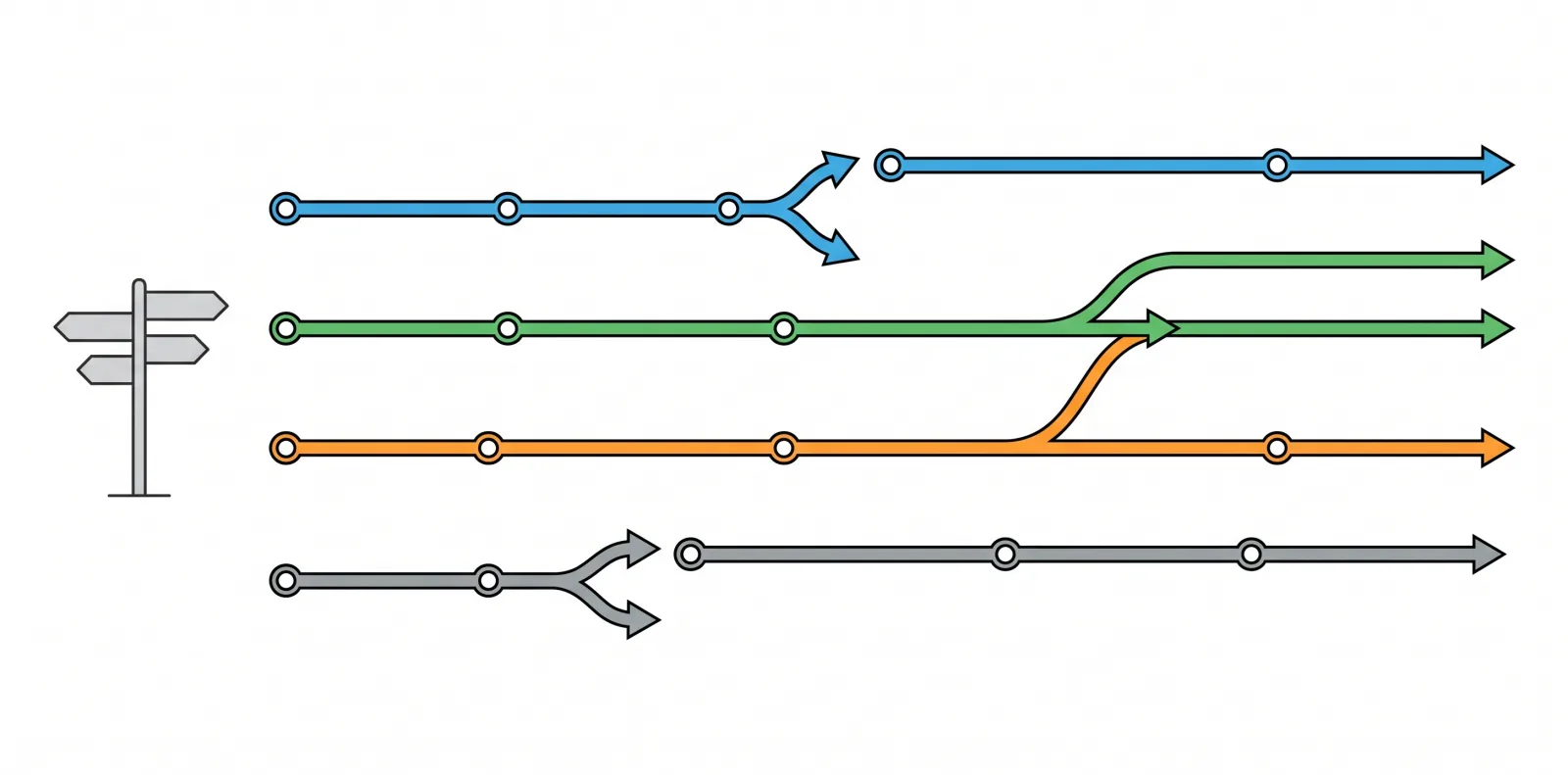
The chart below shows the approximate active periods of each route through the admission season. Exact dates shift every year, so treat this as the shape of the problem rather than a schedule.
Look at the middle of that chart. In July, a student can simultaneously have a JoSAA round decision pending, a state counselling verification date, a medical counselling round and a university admission list. Each of these demands a response within days, and several demand money.
The overlap is the reason to prepare in advance rather than react. Three habits prevent almost all avoidable losses.
Build a single calendar. One document, every portal you are registered on, every date. Check it daily through July and August.
Gather documents once, early. Category certificate, income certificate, domicile certificate, Class 10 and 12 certificates, photographs to specification. Scanned, correctly sized, stored in one folder. Half of all counselling failures are document failures.
Keep money accessible. Seat acceptance fees and security deposits fall due at short notice and are not always small. Knowing where the money will come from before the demand arrives prevents a rushed and bad decision.
Frequently Asked Questions#
Can I participate in JoSAA and state counselling at the same time?#
Yes, and you generally should. They are independent processes. You may hold provisional positions in both until you finally accept one, though you should read each process's rules on withdrawal and fee refunds, since these differ.
If I get a seat in JoSAA, should I still register for CSAB?#
If you are satisfied with your seat, no. If you want to improve it, yes, but understand that participating in CSAB can require you to surrender your existing allotment under certain conditions. Read the current CSAB brochure on exactly this point before registering.
What is the difference between freeze, float and slide?#
Freeze accepts the seat and ends your participation. Slide keeps the institution and lets you move to a better branch within it. Float keeps you in contention for anything higher in your preference list, anywhere. Choose float if you would genuinely be happier elsewhere, and freeze only when you are certain.
Do I lose my allotted seat if I float and nothing better comes?#
No. Floating retains your current allotment as a floor. You cannot end up worse off than the seat you already hold, which is why freezing early out of anxiety is usually a mistake.
I have no domicile certificate. Am I locked out of state counselling?#
You are locked out of the state quota, which is most of the seats. You may still be eligible under any all-India or other-state provision the state offers. Apply for the certificate immediately, since processing takes time and the requirements vary by state.
How many choices should I fill in JoSAA?#
As many as you would genuinely accept, which for most students means dozens. There is no penalty for a long list, and a short list is the most common cause of ending a round with no allotment at all.
Does CUET have centralised counselling like JoSAA?#
No. Each university runs its own admission process using CUET scores, on its own timetable. You must track each university individually. There is no single portal that shows your overall position.
What happens if I miss a document verification date?#
In most processes, your allotment is cancelled and the seat goes to the next candidate. Some processes allow a grievance window, but you should never plan on one. Treat every verification date as immovable.