
The Student Who Did Everything Right And Ended Up With Nothing#
You will meet one. Possibly you will be one.
They prepared seriously for two years. Their score was good, not extraordinary, but comfortably above what a great many students turn into a decent seat. And in August they were sitting at home with no admission anywhere, applying to whatever was still open, taking something they did not want at an institution they had never researched.
What went wrong was not the score. It was the list. They applied to twelve institutions, eleven of which were institutions where a student with their score had a small chance, and one of which was a vague notion that "something local will work out". Nothing local worked out, because they had not applied to anything local, because applying to it felt like an admission of defeat.
This is the most common structural failure in Indian admissions, and it is entirely preventable with an afternoon of arithmetic. Building a college list is an engineering problem with a known solution. Here is the solution.
Background: What Reach, Target And Safe Actually Mean#
The three-tier model comes from American undergraduate admissions and adapts cleanly to the Indian system, provided you define the tiers by data rather than by feeling.
Reach. An institution where your score sits below the recent closing threshold, or where admission depends on factors outside your control. Your realistic probability is low, perhaps in the range of five to twenty-five per cent. You apply because the upside is large and the cost of applying is small.
Target. An institution where your score sits at or slightly above the recent closing threshold for your category and quota. Your probability is meaningful, roughly forty to seventy per cent. This is where your admission will most likely come from, and it deserves the bulk of your research.
Safe. An institution where your score sits comfortably above the recent closing threshold, with a clear margin. Your probability should be above eighty-five per cent. Crucially, a safe option must be somewhere you would genuinely attend.
That last clause is the one people cheat on, and it is the whole point. A safe option you would refuse is not a safe option. It is a decorative entry that makes your list look balanced while leaving you exposed.
Two more concepts:
Closing rank or cut-off. The threshold at which admission closed in a previous cycle for a specific institution, course, category and quota. It is an output of the process, not a promise about the next one.
Correlated outcomes. The statistical fact that your results across institutions are not independent. If you underperform, you underperform everywhere at once. This matters enormously, and we will come to it.
Why The Numbers Favour Safety More Than You Think#
Here is the arithmetic that should change how you build your list.
Suppose you apply to ten reach options, each with an independent ten per cent chance. The probability of at least one offer is one minus the probability of missing all ten, which is one minus nine-tenths raised to the power of ten, roughly sixty-five per cent.
Sixty-five per cent. Ten applications to places you would love, and a one-in-three chance of nothing from any of them.
Now add three safe options at ninety per cent each. The probability of missing all three is one thousandth. You are now effectively certain of a seat.
Now the honest caveat, because this model flatters reality.
Real outcomes are correlated, not independent. Your performance is a single number applied to many institutions. If you score below expectation, you miss every reach simultaneously, and you may miss some targets too. The true probability of at least one reach offer is lower than the chart implies, sometimes considerably.
Correlation cuts the other way too. If you score above expectation, you may collect several reach offers at once.
The practical implication is not that the model is useless. It is that the model understates the value of safe options, because a bad day removes your entire reach tier at a stroke. Safe options are precisely the tier that survives a bad day, since they are chosen with enough margin that even a disappointing score clears them.
Step One: Establish Your Realistic Band#
You cannot classify institutions until you know where you stand. Be ruthless here, because self-deception at this stage propagates through the entire list.
Use your actual data, not your best mock test. Take your last three to five practice or preliminary scores, discard the outlier at each end, and take the range of what remains. That band is your realistic expectation. Your best single score was a good day, and admission does not run on good days.
Convert to the right unit. Different systems use different currencies. JEE gives you a rank, NEET gives you a rank, CUET gives you a normalised score and percentile, CAT gives you a percentile. Make sure you are comparing like with like against published cut-offs.
Apply your category and quota. Closing ranks differ for general, OBC-NCL, EWS, SC and ST categories, and for home state versus other state quotas. Using a general-category figure when you are applying under a different category will misclassify your entire list.
Account for the trend. Look at three years, not one. If a cut-off has tightened each year, assume the tightening continues. If it has loosened, do not assume the loosening will.
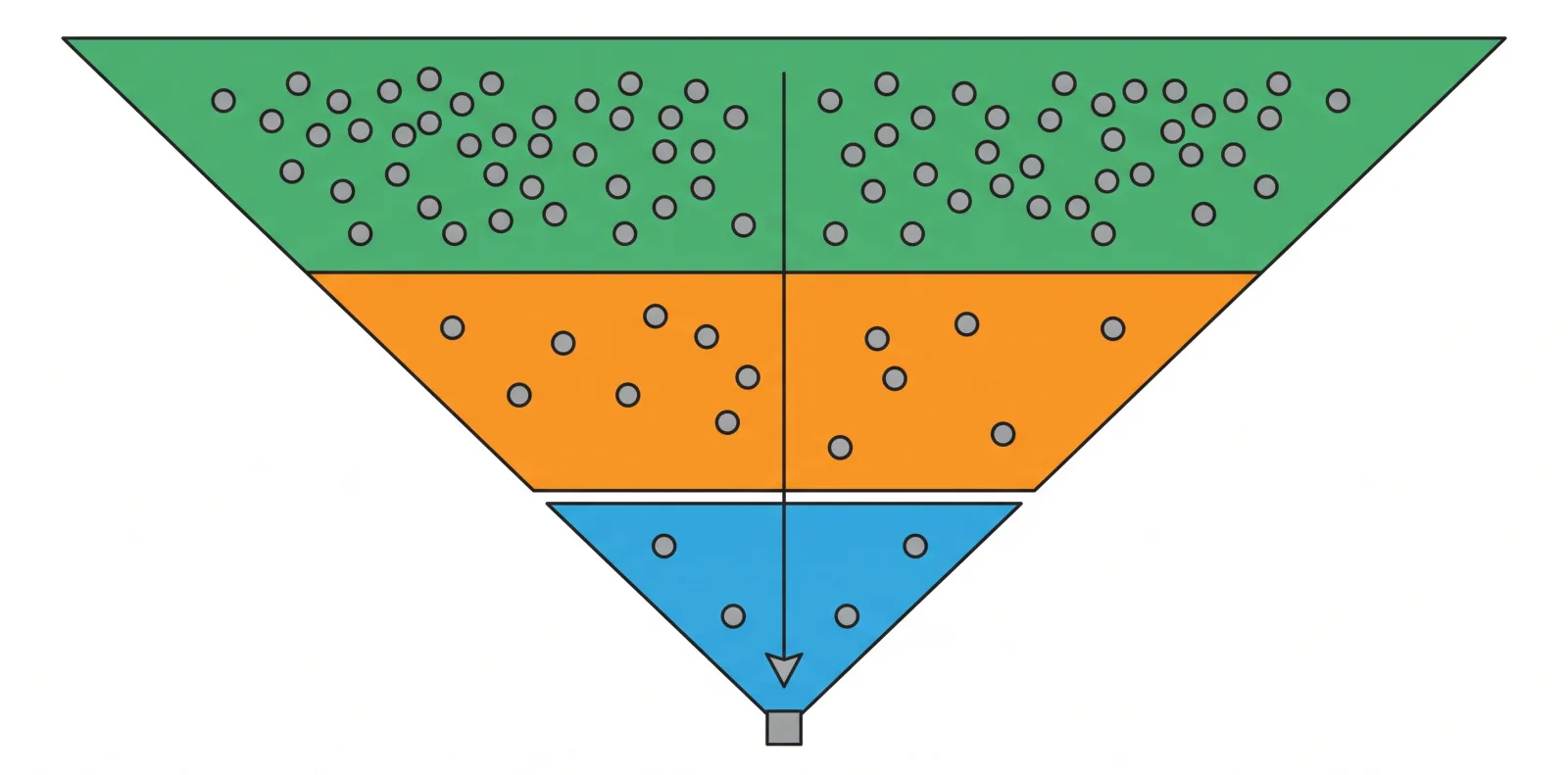
Step Two: Classify Institutions Honestly#
For each institution and course combination, find the closing figure for the last three years in your category and quota. Then classify:
Safe if your lower expected figure clears the worst of the last three years with a comfortable margin.
Target if your middle expected figure sits at or just above the recent closing figures.
Reach if only your best expected figure would clear it, or if it has never closed at your level.
Write this in a spreadsheet with columns for institution, course, category, quota, three years of closing data, your classification and a link to the official admission page. It takes an afternoon and it will be the most useful document you produce all year.
Step Three: Build The List By Route#
The shape differs by admission system, because the mechanics differ.
Engineering through JoSAA and CSAB. This is the easiest case, because you submit a single ordered preference list and the algorithm handles feasibility. The rule is: list everything you would accept, in genuine order of preference, from most wanted to least. Reaches at the top, targets in the middle, safes at the bottom. Do not shorten the list out of embarrassment. Then register separately for your state counselling as an additional layer, and register for CSAB after JoSAA concludes, since vacancies there regularly admit students at ranks that failed earlier.
Medical through NEET. Register for both the central Medical Counselling Committee process and your own state's counselling. These are separate and both matter. Your reach tier will be government colleges at high ranks, your target tier government colleges at mid ranks under state quota, and your safe tier should include options you would genuinely accept, which may mean thinking carefully about private and deemed colleges and their fee implications before you are under pressure.
Arts, science and commerce through CUET. There is no central counselling, so each university is a separate application with its own deadline. This makes the list-building discipline more important, not less, because there is no algorithm catching your mistakes. Build ten to eighteen entries across the tiers, track each university's deadlines and list-release dates separately, and check every one of them through the season, since later lists frequently admit students who missed the first.
Management through CAT and other tests. Apply across institutes in bands, and remember that the shortlist and the final offer are separate stages with different criteria. A call is not an admission.
Step Four: Test The List Against Three Scenarios#
Before you finalise, run your list through three futures.
The bad scenario. You score at the bottom of your expected band. Read down your list. Where do you land? If the honest answer is nowhere, your safe tier is not safe. Add two more, chosen with a larger margin.
The expected scenario. You score in the middle. Where do you land? If the answer is somewhere you would be unhappy, your target tier is wrong, and you need more options at that level rather than more reaches.
The good scenario. You score at the top. Is there anything on your list worth the good day? If every entry would have been reachable anyway, add two genuine reaches. There is no cost to ambition at the top of a list.
A list that survives all three scenarios is a finished list.
The Mistakes That Actually Cause Failure#
Too few entries. The single most common cause of ending a counselling round with nothing. There is no penalty for a long preference list in systems that use one.
Fake safe options. Listing a college you would never attend, so the list looks balanced. When the bad scenario arrives, you refuse the seat, and you are back where you started.
Ordering by probability instead of preference. In algorithmic systems such as JoSAA, this actively harms you. The algorithm already handles feasibility. Your only job is to state what you want most.
Ignoring your home state. Domicile quotas are the single largest advantage most students have and the one most frequently left unused, because a local institution feels less impressive than a distant one.
Applying only to famous names. There are thousands of institutions. The ones you have heard of are the ones everyone has heard of, which is exactly why they are competitive.
Missing deadlines. Especially in CUET-route admissions where each university runs its own timetable. Build a single calendar and check it daily through the season.
Not reading total cost until after admission. Classify by affordability as well as by score. A seat you cannot pay for is not a seat.
Stopping after the first list. Later rounds and special rounds fill a large number of seats as students withdraw. Students who keep checking regularly secure places that were unavailable in round one.
Frequently Asked Questions#
Is ten reach, five target and three safe the right ratio for everyone?#
It is a sensible default, not a rule. If your score band is narrow and well understood, you can carry fewer reaches. If you are applying through a system with one combined preference list, such as JoSAA, the list should be much longer than eighteen entries. The proportions matter more than the absolute numbers.
How do I know whether something is genuinely safe?#
Your lowest expected score should clear the worst closing figure from the last three years, in your category and quota, with a clear margin. If it only clears the best of the three years, it is a target, not a safe option.
Should I include a safe option I would not want to attend?#
No. A safe option you would refuse provides no protection. If you cannot find a safe option you would accept, that is important information, and it means you should widen your search rather than pretend the problem is solved.
Does a long preference list hurt my chances at my top choices?#
No, in systems that allocate by ordered preference. The algorithm assigns you the highest preference you qualify for. Adding lower preferences below it cannot displace a higher one.
How many years of cut-off data should I look at?#
Three. One year is a snapshot that may reflect an unusual paper or an unusual applicant pool. Three years show the direction and the variability, which is what you are actually trying to estimate.
What if my score turns out much lower than expected?#
This is exactly what the safe tier exists for. Take the seat, register for any special or later rounds that remain open, and make a considered decision about whether to attend or reattempt once you have an offer in hand rather than while you are panicking.
Should I include private colleges in my list?#
Include them if you would genuinely attend and can genuinely afford them, and check accreditation and professional recognition before listing. Do not include them as decoration, and do not assume a private option is automatically available, since good ones close early.
When should I build this list?#
Before your results, ideally before your examination. Building it under time pressure after results produces exactly the mistakes this article describes. The data you need is published and available months in advance.