The Same Loan, Five Different Rulebooks#
A student who says "I need an education loan for abroad" has asked a much bigger question than it sounds. A lender asked to fund a year in Germany, a year in Canada and a year in Australia will be looking at three different cost structures. A visa officer will ask for three different kinds of proof. And the rupee, which has weakened about 8 per cent against the dollar over the past year, will make all three bills bigger than they looked in last year's brochure.
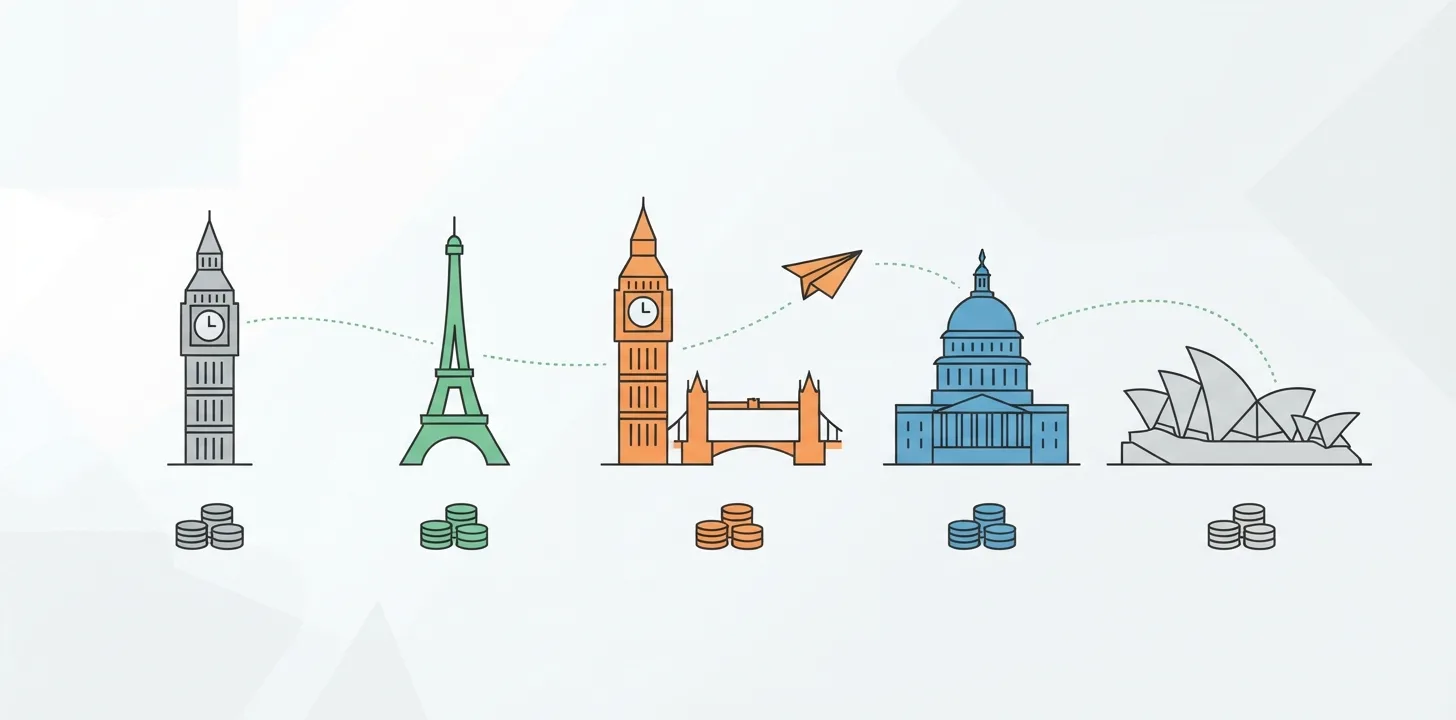
So "how much do I need?" and "what will they fund?" have different answers depending on where you go. This guide walks through five popular destinations, Germany, Canada, the UK, the USA and Australia, and covers three things for each: the money your visa office wants to see, the lenders that commonly serve that route and the traps that catch students most often.
Background: What Overseas Loans Cover, And How Visa Money Fits In#
What lenders usually fund. Tuition, living costs, travel, books, a laptop, and sometimes health insurance and other course-related costs. SBI's Global Ed-Vantage, its main scheme for overseas study, lends from above ₹7.5 lakh up to ₹3 crore, and up to ₹50 lakh without tangible security for students at select premier foreign institutions. Its rate card, effective 9 June 2026, shows 9.40 per cent for the standard product and 8.90 per cent for a secured loan at a select institution. Its page also lists a processing fee of 0.5 per cent of the loan, with a minimum of ₹10,000 and a maximum of ₹50,000, plus GST.
The margin. Under the Indian Banks' Association (IBA) model, students going abroad bring in 15 per cent of the cost above ₹4 lakh. Some premier schemes waive it, so ask.
Visa money versus loan money. These are not the same thing. Each country asks you to show that you can pay for your stay, and an approved education loan can sometimes count as part of that proof. But the rules on what counts differ, and a loan sanction letter that satisfies your bank may not satisfy the embassy.
Currency risk. Overseas fees are paid in foreign currency but repaid in rupees. On late September 2026 rates, a euro is worth about ₹110, a pound about ₹128, and the Canadian and Australian dollars about ₹68 each. Tradingeconomics reports that the dollar touched an all-time high of ₹99.82 in March 2026 and stood near ₹95.9 in late September. A rupee loan sized on last year's exchange rate can fall short.
The chart converts the living-cost money each visa office asks you to show into rupees at those rates. It covers living costs only. Canada, the UK and Australia also expect proof of first-year tuition. For the USA there is no fixed national figure.
Germany: Blocked Account First, Loan Second#
The visa money. For 2026 you must pay €11,904 into a blocked account (a special German bank account that releases a fixed monthly sum, €992, for living costs). That is about ₹13.1 lakh at current rates. It covers living costs only, since tuition at most German public universities is very low or zero, apart from a small semester contribution.
What lenders do with this. A loan from an Indian bank can usually be used to fund the blocked account, once disbursed. The complication is that some banks, working from the IBA model in which an education loan mainly funds tuition, hesitate to lend for a course with almost no tuition. Ask early whether the bank will lend for living costs at a public university, and how it will disburse. SBI's Global Ed-Vantage lists Germany among its covered European destinations, and several non-bank lenders such as Auxilo publish Germany-specific products.
The private-university and private-lender picture. For private universities, or for costs above the blocked amount, lenders such as Prodigy Finance lend against the student's academic profile and future earning potential. A representative example on Prodigy's own Germany guide shows an APR of 13.26 per cent on a $40,000 loan, with an administration fee of 4.2 per cent plus a $500 processing fee. That is far above SBI's rates, which is the price of skipping collateral and a co-signer.
The trap. Germany's low tuition tempts families to borrow little, then discover that living costs and the blocked account are the real expense. Plan the whole first year, not just the fee.
Canada: A Bigger Proof-Of-Funds Number From 1 September#
The visa money. Since 1 September 2026, a single applicant outside Quebec must show at least CAD 23,448 for living costs for the first year, up from CAD 22,895. That is about ₹15.9 lakh. The figure excludes tuition and transport, which you must also cover. Quebec runs its own test, reported at CAD 24,617 from 1 January 2026.
What counts as proof. Canada's own guidance lists six months of bank statements, a guaranteed investment certificate (GIC) from a Canadian financial institution and "proof of a student or education loan from a bank". So a sanction letter can carry weight, but only if it clearly states the amount.
Lenders. SBI's Global Ed-Vantage and Bank of Baroda, Canara, PNB and Union Bank's overseas schemes are all options, alongside non-banking lenders such as Credila and Avanse. Comparison sites report Credila offering up to ₹40 lakh and Avanse up to ₹45 lakh without collateral, at rates roughly from 9.5 to 14.5 per cent, but check the current terms with each lender.
The trap. The living-cost number is adjusted every September, tied to Statistics Canada's low-income cut-off. A plan made a year ago may already be out of date, and the education loan letter must match the current figure, not last year's.
The United Kingdom: Maintenance Money, And A Rise On 30 November#
The visa money. For a Student visa, gov.uk lists £1,529 a month for London and £1,171 a month outside London, for up to nine months. That adds up to £13,761 or £10,539, or roughly ₹17.6 lakh or ₹13.5 lakh at current rates. On top of that you must show first-year tuition, and the funds normally need to have been held for 28 consecutive days.
A coming increase. The Home Office's September 2026 statement of changes, HC 584, confirms that the annual uplift to the maintenance requirement takes effect on 30 November 2026. Several immigration advisers report the new monthly figures as £1,570 for London and £1,203 outside London, though I could not confirm them on the gov.uk pages I could open. If you apply on or after that date, use the new numbers.
Lenders. The same set of Indian banks and NBFCs serve the UK. Because the rules on holding funds and on accepting loan letters are precise, ask your lender whether its sanction letter is in a format the Home Office accepts.
The trap. London versus outside London, and the 28-day rule, catch people who moved money at the last minute. Tuition is separate and is often the bigger part of the bill.
The United States: No Fixed Number, A Different Kind Of Lender#
The visa money. The US has no national living-cost figure. Instead, your university issues an I-20, the certificate of eligibility for an F-1 student visa, which states an estimated cost of attendance. You must show you can cover that. Lenders will not process an application without it.
What lenders do. Indian public sector banks and NBFCs lend for US courses through their overseas schemes. In addition, US-based lenders such as MPOWER Financing and Prodigy Finance lend to international students on the basis of the university and projected earnings, in dollars and without a US co-signer. MPOWER's rates are reported from 9.99 per cent, though comparison sites note it has paused new loans when it reaches funding capacity, including in 2026. Confirm it is actively lending before you build a plan around it.
The trap. Federal student aid is generally unavailable to international students, so the whole cost sits with you and your lenders. Dollar costs meet a rupee near ₹96, so a ₹50 lakh loan is worth far fewer dollars than it was a few years ago. Visa outcomes, work rights after study and the cost of repayment in rupees against dollar earnings all matter. Read up on F-1 visa outcomes and stay-back rules before you commit.
Australia: The Highest Living-Cost Figure Of The Five#
The visa money. For 2026, you must show AUD 29,710 for your own living costs for 12 months, about ₹20.2 lakh, plus first-year tuition and travel. A spouse adds AUD 10,394 and each child AUD 4,449. Funds should show a consistent history over about three to six months, and large sudden deposits need to be explained with evidence. This is not a place for last-minute transfers.
Lenders. SBI's Global Ed-Vantage covers Australia, as do other public sector overseas schemes and NBFCs. Since Australia's living-cost figure is the highest of the five, the margin and living-cost component of your loan matters more.
The trap. The requirement is for living costs only, and it is judged along with the source and accessibility of funds. A loan letter must show that money will actually be available. Ask the lender how its documentation aligns with Home Affairs' requirements.
The thread running through all five. Every visa office wants to see the money in a form it recognises, and every lender wants the institution's fees and a cost estimate first. If you get the documents right in the right order, cost, admission and sanction, then visa, the loan tends to go through. If you work backwards from a country's headline number, you may end up with a loan that satisfies neither.
Frequently Asked Questions#
Which country is cheapest for an education loan?
Germany usually needs the smallest loan because public tuition is low, though you still must fund a blocked account of €11,904 (about ₹13.1 lakh) and living costs. Rates depend on the lender and scheme, not the country, so compare sanctioned offers.
Can I use an education loan as proof of funds for a visa?
In some countries, yes. Canada's guidance lists proof of a student or education loan from a bank among accepted evidence. The UK, USA and Australia have their own conditions, so check that your lender's letter meets the current official requirements.
How much money do I need for a German student visa?
For 2026, €11,904 in a blocked account, released at €992 a month. Certain visa types may require a higher amount. The account covers living costs only.
How much proof of funds does Canada require now?
From 1 September 2026, CAD 23,448 for a single applicant outside Quebec for living costs, plus first-year tuition and transport. Quebec applies a separate figure, reported at CAD 24,617 from 1 January 2026.
What are the UK maintenance funds for a student visa?
£1,529 a month in London and £1,171 a month elsewhere, for up to nine months, held for 28 consecutive days. An increase takes effect on 30 November 2026, so check the new figures if you apply after that.
Do I need a co-signer for a US education loan?
Indian banks generally need a co-applicant, and NBFCs often do. Some US-based lenders such as MPOWER and Prodigy lend without a co-signer, based on the university and expected earnings, though eligibility and availability vary.
How does the weak rupee affect my loan?
Fees are paid in foreign currency, but you repay in rupees. The rupee has fallen by about 8 per cent against the dollar in a year, so the same course costs more rupees. A sensible buffer on the loan estimate, and prepayment when you can, softens the blow.
Figures were checked on 26 September 2026 from SBI's rate card and Global Ed-Vantage page, Canada's IRCC guidance, GOV.UK, UKCISA and Home Office notices, published Germany blocked-account guides, Australia's living-cost figure as reported by migration advisers, and exchange rates from Trading Economics and X-Rates. Exchange rates and visa rules change often, so confirm with the official source before you rely on any figure.