
Quitting Buys You Fewer Hours Than You Think#
The assumption behind most resignation decisions is arithmetic: a job consumes roughly nine hours a day, so quitting releases nine hours a day for preparation.
It does not, and this is worth working through carefully before you hand in notice.
Sustained, genuinely focused study has a ceiling. Most people manage somewhere between six and eight hours of real concentration a day, and that is on a good day with everything else handled. The full-time aspirant who plans fourteen hours delivers six or seven, then spends the remaining time feeling guilty about the gap.
Meanwhile the working aspirant who protects two and a half hours on weekdays and eight across the weekend is delivering around twenty focused hours a week. The full-time aspirant at six hours a day delivers around forty. So quitting roughly doubles your study time rather than multiplying it fivefold.
Doubling is significant. It is also not obviously worth surrendering an income, a career trajectory and your fallback position, particularly given what the odds look like against 933 vacancies. Here is the plan that works alongside a job, and the framework for deciding whether to leave it.
Background: What Actually Needs Long Blocks, And What Does Not#
The key insight for a working aspirant is that UPSC preparation is not one uniform activity. Its components have very different time-block requirements, and knowing which is which lets you fit the work into the time you have.
Needs long uninterrupted blocks. Full-length answer writing practice, which requires sustained focus for ninety minutes or more. Full mock tests. First-pass reading of a dense new subject.
Works perfectly well in short blocks. Newspaper reading. Revision of previously covered material. Current affairs notes. Single-question answer writing. Vocabulary and factual consolidation. Listening to lectures during a commute.
Works in very short blocks. Flashcard-style revision of schemes, committees, articles and dates. Reviewing your own notes.
The practical consequence. A working aspirant should protect weekends for the long-block activities and fill weekdays with everything else. The common failure is attempting first-pass reading of a difficult new topic at eleven at night after a full working day, retaining almost none of it, and concluding that preparation while working is impossible.
Two terms worth defining:
Prelims-Mains integration. Preparing a topic once for both stages rather than twice. Essential when time is constrained, and it means reading with Mains depth from the start rather than doing a shallow Prelims pass and a deep Mains pass.
Optional subject. One subject examined in two papers at Mains, chosen by you. For a working professional, choosing a subject connected to your degree or your work is worth serious consideration, because familiarity converts directly into saved hours.
The Two-Year Plan At Fifteen To Twenty Hours A Week#
| Period | Weekday cadence, about 2 to 2.5 hours | Weekend cadence, about 7 to 9 hours | What you should have finished |
|---|---|---|---|
| Months 1 to 6 | One hour newspaper and current affairs notes. One hour NCERT or standard text reading | First-pass reading of a core subject. Begin answer writing at one or two answers per session | Polity, modern history, geography and economy at foundation level. A working notes system |
| Months 7 to 12 | Newspaper continues. Revision of covered material. Optional subject reading two evenings a week | Optional subject first pass. Answer writing to three or four answers per session | Optional subject covered once. Core general studies read once with notes |
| Months 13 to 18 | Newspaper. Revision cycles. Short answer writing on weekday evenings | Full-length answer writing under time. Sectional mock tests | Second pass of all general studies. Optional subject second pass. Answer writing established as a habit |
| Months 19 to 22 | Newspaper. Current affairs consolidation. Flashcard revision | Full mock tests weekly, analysed the same day | Three revision cycles complete. Mock performance stabilised |
| Final 2 months before Prelims | Shift weekday time to objective practice | Full Prelims mocks and CSAT practice | Prelims-ready, with Mains material revised and waiting |
Two rules that make this survive contact with a job.
Protect the weekday minimum absolutely. Two hours on a bad day is infinitely better than zero, because the habit is what carries you through twenty-four months. An aspirant who studies five hours on good days and nothing on bad ones covers less ground than one who never misses two.
Use the commute. Audio lectures, recorded current affairs discussion, your own recorded notes. For many working aspirants this recovers five to eight hours a week that would otherwise be lost entirely.
And take leave strategically rather than continuously. Most working aspirants find that concentrated leave in the six to eight weeks before Prelims, and again between Prelims and Mains, delivers far more value than an earlier resignation. This is the single most efficient use of a professional's flexibility.
The Quit-Or-Stay Decision#
Now the harder question, and it deserves arithmetic rather than sentiment.
What quitting genuinely buys you. Roughly double the weekly study hours, as established. Mental bandwidth freed from work problems. Flexibility to align your schedule to the examination calendar. For candidates in genuinely punishing jobs with unpredictable hours, considerably more than double.
What quitting genuinely costs you. Your salary for however many years you attempt, which for a qualified engineer or chartered accountant is a substantial sum compounding across the period. Career progression you do not get back, since a two-year gap at twenty-six is different from continuous advancement. Your fallback position if the attempts do not succeed. And, less discussed, the psychological weight of having nothing else, which changes how a disappointing result feels.
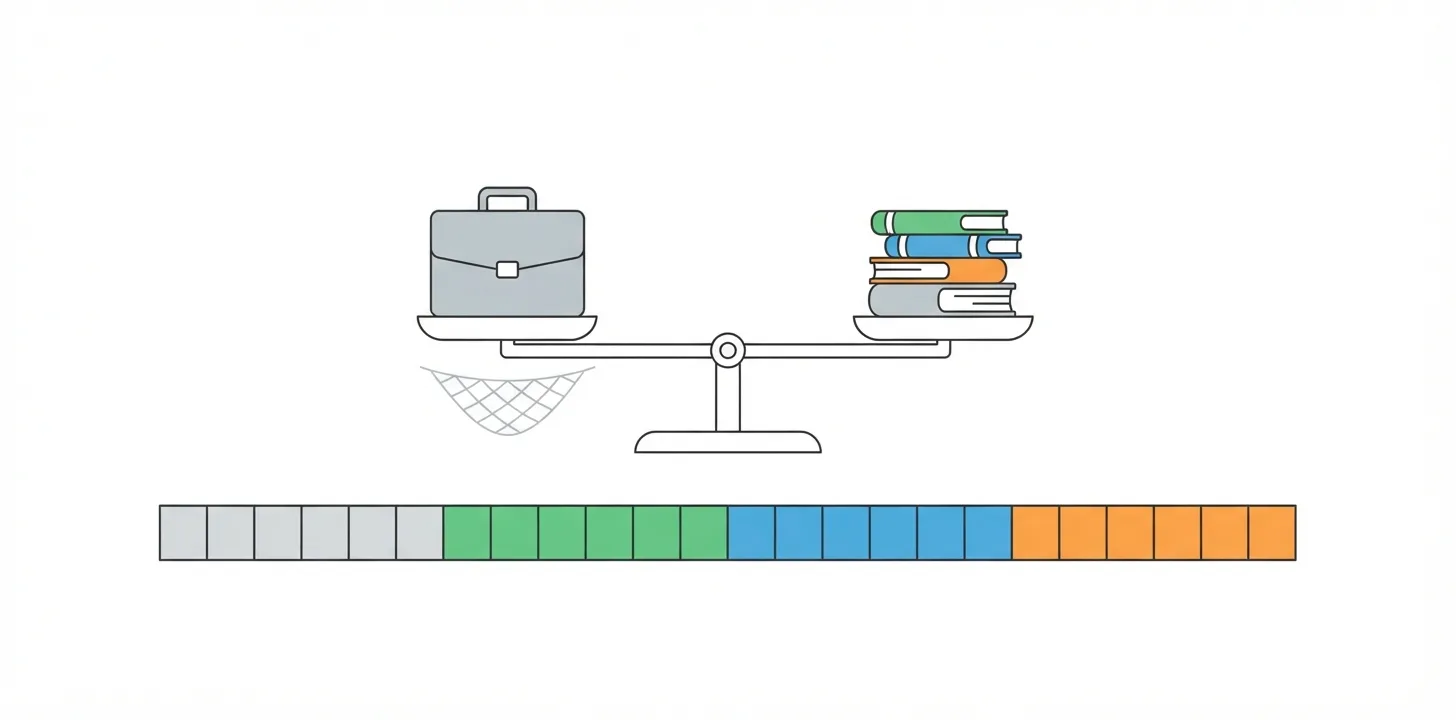
The framework. Answer these five honestly.
How many attempts will you make? Decide the number before you decide about resigning. A plan for one attempt and a plan for four are completely different financial propositions.
What is your total cost across that period? Forgone salary multiplied by years, plus living costs and coaching if you use it. For a professional earning twelve lakh a year planning three attempts, that is upwards of thirty-six lakh in forgone earnings alone.
What is your re-entry position? This is where the CA and engineer cases differ sharply. A chartered accountant can generally return to practice or industry after a gap, because the qualification does not expire and the skills remain current. A software engineer faces a harder return, because technical skills and stack familiarity decay and the market reads gaps in early-career technical roles less generously. If you are in the second category, the cost of quitting is materially higher, and preparing alongside work is correspondingly more attractive.
Do you have a financial cushion, and who else depends on it? Preparing without income while family depends on you introduces a pressure that measurably damages performance. This is not weakness; it is how sustained financial stress works.
Have you completed one full attempt already? This is the most useful filter of all. Sit Prelims once while working before making any resignation decision. A real attempt tells you far more about your realistic position than any amount of speculation, and many aspirants discover after one cycle either that they are closer than they thought or that this is not the right path for them.
What the evidence broadly supports. Successful candidates come from both routes. There is no reliable finding that full-time preparation produces better outcomes once you control for how long someone has been preparing. What full-time preparation reliably does is compress the timeline and raise the stakes.
The middle path most people miss. Prepare while working for the first cycle. If your first attempt shows you are genuinely in contention, meaning you cleared Prelims or came close, then consider a focused resignation or an extended leave for a single serious attempt with a defined end date. That sequence gives you information before it takes your income.
Making It Work Day To Day#
Tell your employer or do not, deliberately. Some organisations are supportive and will accommodate leave; others treat it as disloyalty. Assess your own workplace rather than following general advice, and consider the consequences of disclosure before you make it.
Build the notes system early. One place for everything, organised by syllabus topic, revised rather than rewritten. Working aspirants cannot afford to relearn material they have already covered because they cannot find their notes.
Protect sleep aggressively. Six hours of sleep with two hours of focused study beats four hours of sleep with four hours of unfocused study, and the deficit compounds across two years.
Have one day a fortnight genuinely off. Not a guilty half-study day. Sustained two-year efforts fail on burnout far more often than on ability.
And keep a parallel option warm. A state PSC attempt, where syllabus overlap is high and the vacancy-to-candidate ratio is frequently better, costs little additional preparation and provides both a genuine alternative outcome and useful examination-hall experience.
A Notes System That Survives Two Years#
A working aspirant cannot afford to relearn material. The notes system is what prevents that, and most people build it badly.
One location, organised by syllabus topic. Not by source, not by date, not by which book you were reading. When you revise polity, everything you have on polity should be in one place. Candidates who keep notes by source end up with the same topic scattered across four notebooks.
Write notes once, then only revise them. The temptation to rewrite notes each cycle feels productive and is largely wasted time. Add to existing notes rather than starting fresh.
Keep them short enough to actually revise. Notes that run to the length of the original text serve no purpose. The test is whether you can revise a full subject's notes in an evening. If you cannot, they are too long.
Current affairs go into the same topic structure, not a separate chronological file. A news item about a governance reform belongs with your polity notes, where you will find it when revising. A chronological current affairs file is unrevisable by month eighteen.
Digital or handwritten both work. Digital is searchable and portable, which matters on a commute. Handwritten aids retention for many people. What matters is that there is one system rather than two half-systems.
And build in the first three months. Notes made later, under time pressure, are worse and there is less time to use them. The early months are when you have the most capacity and the least urgency.
The Window Between Prelims And Mains#
For a working aspirant this period is the highest-leverage stretch of the entire cycle, and it is short.
It is roughly three months. Prelims results arrive, and Mains follows within a defined window. In the 2026 cycle, Prelims fell on 24 May with results on 15 June and Mains beginning on 21 August.
This is where your concentrated leave belongs. If you have flexibility to take extended leave once, take it here rather than earlier. The marginal value of full-time preparation is far higher in this window than at any other point, because the work is answer writing under time, which is exactly what a job's fragmented hours cannot accommodate.
Write, do not read. The instinct after clearing Prelims is to revise content. The constraint at Mains is almost never knowledge; it is the ability to structure an argument within a word limit at speed. Aim for a substantial volume of full-length answers across the window, reviewed rather than merely produced.
Complete the Detailed Application Form carefully. It opens immediately after Prelims results and it becomes your interview material months later. Do not rush it in the excitement of having cleared.
Revise the optional subject properly. Two papers with substantial weight, and candidates frequently arrive at Mains with the optional under-revised because general studies felt more urgent.
And protect your health across the window. Five days of examinations in two sessions daily is physically demanding, and candidates who arrive exhausted underperform in the later papers regardless of preparation.
Frequently Asked Questions#
How many hours a week do I need while working?#
Fifteen to twenty focused hours is a workable target, built from around two to two and a half hours on weekdays and seven to nine across the weekend. Consistency matters considerably more than any individual week's total.
Does quitting my job really double my study time?#
Roughly, yes, and not much more. Sustained focused study has a ceiling of around six to eight hours a day for most people, so a full-time aspirant is not delivering fourteen hours. Weigh that doubling against the income, progression and fallback you surrender.
Should a chartered accountant or engineer quit?#
The re-entry position differs. A chartered accountant can generally return to practice or industry after a gap. Early-career technical roles are less forgiving of gaps as skills and stack familiarity decay. That asymmetry should weigh directly on the decision.
What should I do before deciding to resign?#
Sit one full Prelims attempt while working. A real attempt gives you far better information about your position than speculation, and many aspirants change their decision entirely after one cycle.
Which parts of preparation need long blocks?#
Full-length answer writing, mock tests and first-pass reading of dense new subjects. Newspaper reading, revision, current affairs notes and single-question answer practice all work in short weekday blocks.
How should I use annual leave?#
Concentrated in the six to eight weeks before Prelims, and again between Prelims and Mains. This is usually far more valuable than resigning earlier, and it is the main advantage a working aspirant has over a full-time one.
Which optional subject suits a working professional?#
Often one connected to your degree or your work, because existing familiarity converts directly into saved hours. Weigh that against genuine interest and the availability of material, since you will live with the choice for two years.
Is preparing while working actually realistic?#
Yes, and many successful candidates have done it. It extends the timeline and demands disciplined daily cadence rather than long weekend bursts, but it removes the financial pressure that damages performance and leaves you with a career whatever the outcome.