
You Are Not Unlucky. You Are Under-Applying.#
A student who has sent forty applications over three months and received two replies concludes that the market has no room for them.
The market may well be difficult. But forty applications over three months is not a job search. It is a hobby.
Off-campus hiring is a funnel with harsh arithmetic at every stage. Cold applications through job boards convert at low single-digit percentages into any response at all, and a fraction of those into interviews, and a fraction of those into offers. Run the numbers backwards from one offer and the required volume at the top is considerably larger than most students imagine.
Which means the two things that matter are volume and channel. Volume, because the conversion rate is what it is. Channel, because one route through the funnel has dramatically better economics than the others, and most students do not use it.
This is not motivational advice. It is a description of a pipeline and how to operate one.
Background: Why The Funnel Is So Narrow#
Applications vastly exceed openings. A single advertised fresher role at a recognisable employer attracts applications in the hundreds or thousands. No human reads them all, which is the origin of everything that follows.
Software filters first. Most medium and large employers use an applicant tracking system, which stores applications and filters them against the role's requirements before a person sees anything. A CV that does not contain the words the system is matching against does not reach a human, regardless of how well qualified you are.
Recruiters then scan, rather than read. Those that survive the filter receive a few seconds of attention each. This is why structure and specificity in a CV matter more than eloquence.
And employers prefer warm candidates. A referred candidate is pre-filtered by someone with a reputation at stake, which is worth a great deal to a recruiter facing a thousand cold applications.
Two terms worth defining:
Applicant tracking system. Software that stores, parses and filters job applications. It is why plain, conventionally structured CVs outperform designed ones, and why the words you use matter.
Referral. An application submitted or endorsed by a current employee. Most employers run formal referral programmes, often with a bonus for the employee, which is why people are more willing to refer than students expect.
The Funnel, And Where To Intervene#
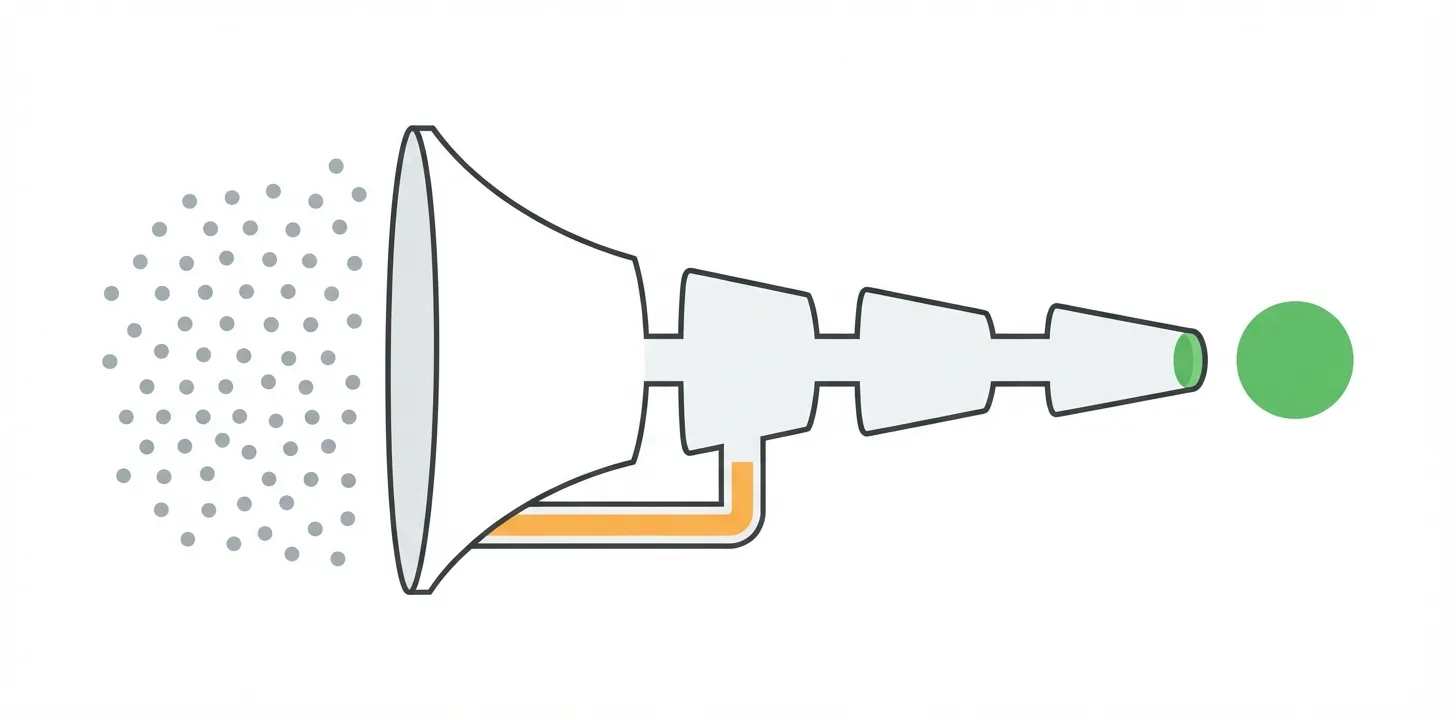
The whole argument is in the bottom row. A referral does not merely improve your chances at each stage; it removes the two stages where most candidates are eliminated. That is why one afternoon spent finding people to ask is worth more than a week of applications.
And the top row explains the volume requirement. If application-to-interview conversion is a few percent, then producing several interviews requires several hundred applications. Students who send forty are not unlucky; they are drawing a conclusion from a sample too small to contain an offer.
Getting Referrals, Which Students Find Uncomfortable#
This is the highest-value activity in an off-campus search and almost nobody does it properly.
Start with alumni of your own institution. Response rates from people who attended your college are dramatically higher than from strangers, for reasons that have nothing to do with your CV. Most professional platforms let you filter by institution and employer. This is the single most efficient thing available to you.
Understand that referring you benefits them. Most employers pay a referral bonus to employees whose referred candidates are hired. You are not asking for charity; you are offering someone a chance at a bonus for two minutes of effort.
Ask correctly. Identify a specific open role first, then approach. A message asking someone to refer you for a named position with a requisition number is easy to act on. A message asking whether there is anything going at their company is not.
Make it effortless for them. Include the role, the link, your CV and two lines they can paste into the internal system. The easier you make it, the more likely it happens.
Ask several people, not one. Referrals go unanswered for entirely ordinary reasons. Ask five people at five companies rather than waiting a fortnight on one.
Do not exaggerate the relationship. Approaching a stranger honestly as a student from the same college works. Implying a connection you do not have does not.
And ask for conversations too, not only referrals. Fifteen minutes about what a team actually does produces information, a contact, and frequently a referral offered without being requested.
Running It As A System#
An off-campus search fails through inconsistency more often than through incapability. Treat it as a weekly operation.
Set weekly targets, not daily moods. A workable rhythm is a defined number of applications, a defined number of referral approaches and a defined number of follow-ups each week. Write the numbers down. The point is that the pipeline keeps filling on the days you do not feel like it.
Keep a tracker. Company, role, date applied, channel, contact, status, follow-up date. A spreadsheet is enough. Without one you will duplicate applications, forget follow-ups and lose track of who replied.
Batch similar work. An hour of sourcing roles, then an hour of tailoring applications, then an hour of outreach is far more efficient than switching between them.
Tailor lightly but always. Reordering your CV so the most relevant project appears first, and matching the vocabulary of the job description, takes a few minutes and materially affects whether the filter passes you.
Follow up once, after about ten days, briefly, on the original thread. Once.
Protect a fixed block of time for skill work. A search that consumes every waking hour and adds no capability leaves you in the same position three months later. Two or three hours a week on a named skill keeps your candidacy improving while the pipeline runs.
And review monthly rather than daily. Look at where candidates are dropping out of your own funnel. No responses at all suggests a CV or filtering problem. Responses but no interviews suggests a screening problem. Interviews but no offers suggests an interview problem. Each has a different fix, and you cannot see the pattern by checking your inbox hourly.
Getting Past The Software Filter#
Since most applications die before a human sees them, it is worth knowing how that filter works.
Use the words the job description uses. If the role asks for a named tool or technology and you have used it, that exact term should appear in your CV. Filters match against terms, not against synonyms or implications.
Keep the format conventional. Standard section headings, a single column, no text embedded in images, no unusual fonts, no tables holding your work history. Designed CVs that look impressive to a human frequently parse into nonsense.
Submit the format requested, and where there is a choice, a plain document or PDF generated from text rather than a scan.
Fill in the form fields properly, even when they duplicate your CV. Many systems filter on the structured fields rather than the attached document, and a half-completed form is a half-completed application.
Do not stuff keywords. Listing thirty technologies you have never used passes the filter and then fails the interview, which is a worse outcome than not passing.
And apply through the employer's own careers page where one exists, rather than only through an aggregator. Applications submitted directly are more reliably received and frequently reach the system in better shape.
Surviving The Part Nobody Warns You About#
An off-campus search is the first extended period of sustained rejection most students have experienced, and the psychological cost is the commonest reason searches are abandoned rather than completed.
Understand what silence actually means. A non-reply means an overloaded inbox, a filled role, a filter, or a hiring freeze announced internally last week. It almost never means a considered judgement about you, because in most cases nobody made one.
Separate effort from outcome. You control applications sent, referrals asked for and skills built. You do not control who is hiring this quarter. Measure yourself against the first set, because it is the only one that responds to your effort.
Keep a written record of what you have learned, not only of where you applied. Three months of searching while acquiring a capability is a period with something to show for it. Three months of refreshing job boards is not, and the difference is visible in interviews.
Do not search alone if you can avoid it. A weekly conversation with one other person doing the same thing keeps the routine intact on the weeks when motivation does not. Classmates in the same position are the obvious candidates.
Set boundaries on the search. Fixed hours, and time genuinely away from it. A search that expands to fill every hour produces worse applications, not more of them.
And be careful what you compare yourself against. Placement announcements on social media are a filtered sample, since nobody posts about the offer they did not get. The comparison is inaccurate and it costs you more than it informs you.
Frequently Asked Questions#
How many applications does an off-campus search actually need?#
Considerably more than most students send. Application-to-interview conversion through cold channels runs in low single-digit percentages, so producing several interviews generally requires several hundred applications. Forty over three months is too small a sample to conclude anything.
Why are referrals so much more effective?#
A referral skips the two stages where most candidates are eliminated: the software filter and the recruiter's initial scan. It also carries the endorsement of someone with a reputation inside the company, which is worth a great deal against a thousand cold applications.
Is it acceptable to ask a stranger for a referral?#
Yes, if you do it well. Identify a specific open role, approach honestly as a student from the same institution, and make it effortless by including the role, the link, your CV and two lines they can paste. Most employers pay referral bonuses, so you are offering something rather than only asking.
What is an applicant tracking system?#
Software that stores and filters applications before any person reads them. It is why plain, conventionally structured CVs outperform designed ones and why using the exact terms from the job description matters.
Why do I never hear back at all?#
Most commonly because the application did not pass the filter. Check that your CV uses the vocabulary of the job description, is in a conventional single-column format with standard headings, and that you completed the structured form fields rather than relying on the attachment.
How often should I follow up?#
Once, after roughly ten days, briefly, on the original thread. Further follow-ups rarely help and can harm.
How do I know what to fix in my search?#
Look at where your own funnel breaks. No responses suggests a CV or filtering problem. Responses without interviews suggests screening. Interviews without offers suggests interview performance. Review monthly rather than daily, because daily data is noise.
Should I keep learning while searching?#
Yes, and protect the time deliberately. A search that consumes everything and adds no capability leaves you identically placed three months later. A few hours a week on a named skill keeps your candidacy improving while the pipeline runs.